
What Is an AI Accountant? A UK Firm's Guide for 2026
An AI accountant is software that performs the judgement-led work of a qualified accountant. It reviews a client file, spots what looks wrong, drafts the query email and answers a UK tax question, rather than simply automating data entry. It does not replace the person who signs the accounts. It replaces the third read-through at half past nine on a Tuesday night.
That distinction matters far more than the marketing around it, so it is worth being precise about the term before anyone signs a subscription.
The short answer
An AI accountant is a system that applies accounting reasoning to client data and produces reviewable output, including review points, schedules, drafted correspondence and technical answers, with every figure traceable back to a source document.
Three things separate one from the AI features now bundled into most accounting software.
- It works on the whole file, not one transaction. Categorisation tools look at a bank line. An AI accountant looks at the ledger, the trial balance, the prior year and the supporting documents together, and asks whether the picture holds up.
- It produces output a senior would recognise. A list of review points with reasons. Lead schedules that tie. The query email you would actually send.
- It shows its working. Every number on a schedule points back to the document it came from. Where the evidence is missing, it says so rather than producing a figure.
Fail any of those three and what you have is accounting software with AI in it. That can still be useful. It is not an AI accountant.
AI accountant vs AI features in accounting software
The two get conflated constantly, usually by people selling the second and describing the first.
| AI features in accounting software | An AI accountant | |
|---|---|---|
| Scope | One task at a time, such as coding a transaction or matching a receipt | The whole engagement file |
| Output | A suggestion to accept or reject | Review points, schedules, drafts and answers |
| Reasoning | Pattern-matching against past behaviour | Applies accounting and UK tax logic to this specific file |
| Evidence | Rarely shown | Every figure traced to source |
| Who it helps | The person doing the input | The person doing the review |
| What it saves | Minutes per transaction | Hours per file |
The right-hand column is where the bottleneck actually sits. Junior preparation has been getting cheaper for a decade. Partner review has not, because it is the part that needs someone to look at a file and know, from experience, that the director’s loan account does not make sense.
Our earlier piece on how AI works inside modern accounting software goes through the mechanics in detail.
What an AI accountant does inside a UK practice
Day to day, the capability breaks into five jobs.
1. Reviewing files to a senior standard
The system reads the imported ledger against the trial balance, prior-year figures and supporting documents, then raises review points in the language a manager would use: “Repairs and renewals £14,200, 41% above prior year, no invoice over £5,000 attached, consider capitalisation.” You are still deciding. You are no longer hunting.
In Papercare this is the AI accounts review, and every point it raises is tracked through to sign-off on the review points screen.
2. Building working papers that tie
Statutory lead schedules, control account reconciliations and checklists prepared from source data rather than rekeyed from a spreadsheet. This is where the time saving is easiest to measure, and where traditional working papers stop being fit for purpose.
This is what we mean by AI working papers: the schedules, reconciliations and checklists are built and checked by the AI accountant, then signed off by a person. We go into it in how AI is transforming working papers for UK accountants, and our guide to working papers software covers what belongs in the file.
3. Answering UK tax questions
VAT liability, capital allowances, CGT on a property disposal, the treatment of a specific benefit in kind, answered against UK legislation and HMRC guidance rather than a general model’s recollection of the internet. Jurisdiction is not a detail here. A US-trained model will confidently give you US answers.
Papercare’s UK tax AI assistant shows the sources it searched alongside every answer, so the reasoning can be checked before it reaches a client.
4. Drafting client communications
Chase emails, query lists, year-end letters, explanations of a tax position in language the client will actually read. Drafting is the most common use of AI in UK practices today and the easiest win to take.
5. Searching what the firm already knows
Previous engagements, internal guidance, filed correspondence. Most firms already hold the answer to the question being asked. It is in a folder nobody can find.
Where UK firms actually are with this
There is a great deal of noise about AI adoption and very little sober data, so it is worth grounding this in numbers from practitioners rather than vendors.
AccountingWEB, working with Sage, surveyed more than 600 members in practice and business for its February 2026 state-of-the-nation report. It found:
- 71% use external AI tools such as ChatGPT, Gemini or Microsoft Copilot
- 45% use AI or machine learning to automate repetitive work such as invoice processing or bank reconciliation
- 66% believe their core accounting software already includes AI, with a further 14% unsure
- 42% say AI has cut time spent on manual tasks
- 53% report only minimal or moderate benefit, and just 7% describe the impact as transformational
- 38% rate their practice as having limited or no readiness for AI
Those figures describe a very specific problem. Adoption is high. Impact is low. Firms have plenty of AI. What they do not have is AI doing the expensive work.
The report’s own summary is that AI in accounting is no longer a novelty but not yet a trusted colleague, closer to a capable junior needing constant supervision.
The reason shows up in the same research. The top-ranked concern among UK accountants is accuracy and hallucination, ahead of data security. That concern is entirely rational. A general-purpose chatbot asked to summarise a set of accounts will produce a confident number whether or not the number exists.
We have written separately on whether UK firms are genuinely ready for AI or just talking about it.
Why "never invents a number" is the only question that matters
In most professions a plausible but wrong answer is an inconvenience. In accountancy it is a filed set of statutory accounts.
This is the design question that separates tools you can put near a client file from tools you cannot. A language model asked to generate text will generate text. Asked for a figure it does not have, it will produce one that looks right. The only workable answer is architectural. Figures must come from source documents and calculations, never from the model’s own generation, and where the evidence is absent the system must refuse rather than guess.
When evaluating any AI accountant, ask this first, and do not accept a reassuring answer. Ask to see what happens when the source document is missing.
What an AI accountant cannot do
Being straight about the limits is more useful than another list of benefits. Any vendor unwilling to give you this list is telling you something.
- It cannot take professional responsibility. Sign-off stays with a qualified person. ICAEW, ACCA and AAT guidance is consistent that technology does not transfer accountability. The PCRT bodies issued specific guidance on the ethical use of AI tools in January 2026.
- It cannot exercise commercial judgement. Whether an expansion plan is sensible, whether a valuation assumption is defensible, whether a director is being straight with you. None of that is in the ledger.
- It cannot manage the relationship. Difficult conversations about fees, going concern, or a mistake your firm made are not a drafting problem.
- It cannot fix bad source data. If the bookkeeping is a mess, AI gives you a faster route to a messy answer. Structure first, which is the same point that applies to the hidden cost of running practices on Excel.
- It cannot make novel technical judgements. Unusual transactions, first-instance interpretations, anything genuinely arguable. Still yours.
The UK compliance context nobody can ignore
The timing is not accidental. UK practices are absorbing an unusual volume of regulatory change at once, and it is squeezing capacity from several directions.
- Making Tax Digital for Income Tax went live on 6 April 2026 for sole traders and landlords with qualifying income over £50,000, dropping to £30,000 from April 2027 and £20,000 from April 2028 (GOV.UK). Each wave converts clients who needed one annual conversation into clients who need four.
- Companies House identity verification becomes enforceable when the transition period ends on 17 November 2026. Every director and PSC on your client list needs verifying.
- HMRC’s agent multi-factor authentication switches on across all agent accounts between 28 September and 15 October 2026, with individual activation dates not notified in advance (Agent Update 146).
None of these makes a firm more money. All of them consume the same hours. That is the honest commercial case for automating compliance review. Not that AI is exciting, but that the compliance base is growing faster than anyone is hiring. Our guide to preparing for MTD for Income Tax covers the operational side.
Eight questions to ask before buying an AI accountant
A practical evaluation checklist, in the order we would ask.
- Where does each figure come from? Ask for a live demonstration of traceability, not a slide about it.
- What happens when a document is missing? The right answer is a flag, not an estimate.
- Is the tax knowledge UK-specific, and when was it last updated? Ask against what source.
- Where is client data hosted, and is it used for training? UK hosting and no training on client data is the baseline.
- Does it produce reviewable output or a black-box answer? You need to be able to defend the file.
- Does it import from Xero, QuickBooks and Excel without rework? Migration friction kills more rollouts than pricing.
- Was it built by people who do this work? Accounting software built without practitioners in the room shows it within a fortnight.
- What happens to your existing working papers? A tool requiring you to abandon five years of file history is a bigger project than it looks.
Papercare was built and tested inside a live UK practice by a founder who still signs accounts. That is why “never invents a number” sits at the centre of the product rather than in the marketing.
Frequently asked questions
Do AI accountants actually exist, or is it marketing?
Both. Systems that genuinely review files, produce working papers and answer UK tax questions exist and are in daily use in practices. So do tools that have relabelled transaction categorisation as an “AI accountant”. The traceability test above separates them quickly.
Can AI do accounting on its own?
It can do large parts of the preparation, including structuring a trial balance, building lead schedules, flagging anomalies and drafting correspondence. It cannot complete an engagement on its own, because sign-off requires a qualified person to take responsibility for the judgement.
Will AI replace accountants?
No, and the framing is wrong. AI replaces specific tasks, such as first-pass review, schedule preparation and drafting. It does not replace the professional. It cannot hold responsibility, exercise commercial judgement or manage a relationship. The realistic outcome is fewer hours on compliance preparation, not fewer accountants.
The full UK answer, with dates and ICAEW evidence, is in will AI replace accountants?
How does an AI accountant work?
It imports client data from a bookkeeping system or spreadsheet, structures it into a trial balance and lead schedules, compares the file against prior periods and supporting documents, then produces review points, drafts and answers, with every figure traced back to source.
Is an AI accountant safe to use with client data under UK GDPR?
It depends entirely on the vendor. Look for UK data hosting, firm-level segregation and an explicit contractual commitment that client data is not used to train models. Consumer chatbots do not meet this bar and should not have client files pasted into them.
Will an AI accountant work with Xero or QuickBooks?
A credible one imports directly from both, and from Excel for clients who are not on a cloud ledger.
To be specific about Papercare: QuickBooks Online connects directly over its API, Xero comes in as a general ledger export in Excel or CSV with no reformatting, and Excel files work for clients on any other software. The Seamless Import page sets out each route.
Is accounting AI-proof?
Preparation is not. Judgement, professional responsibility and client relationships are. The roles most exposed are those built purely on processing volume, which is also where UK firms have struggled hardest to recruit.
Is there an AI accountant built for UK practices?
Yes, though most AI accounting software is built for the US market first. A UK AI accountant needs UK tax logic (HMRC guidance, UK GAAP, Making Tax Digital) and UK data hosting. Ask any vendor which jurisdiction its tax answers come from.
Is an AI accountant the same as AI accounting software?
Not quite. AI accounting software is a broad label, and most of it adds AI to bookkeeping: coding transactions or reading receipts. An AI accountant is AI accounting software built for the practice rather than the client. It works on the whole file, reviewing it, raising review points and drafting the client email.
What is the difference between an AI accountant and AI working papers software?
AI working papers software holds and structures the file: lead schedules, reconciliations and checklists. An AI accountant works on that file, reviewing it, raising review points and drafting the client email. In Papercare they are the same product: the working papers are where the AI accountant does its work.
Can AI do bookkeeping?
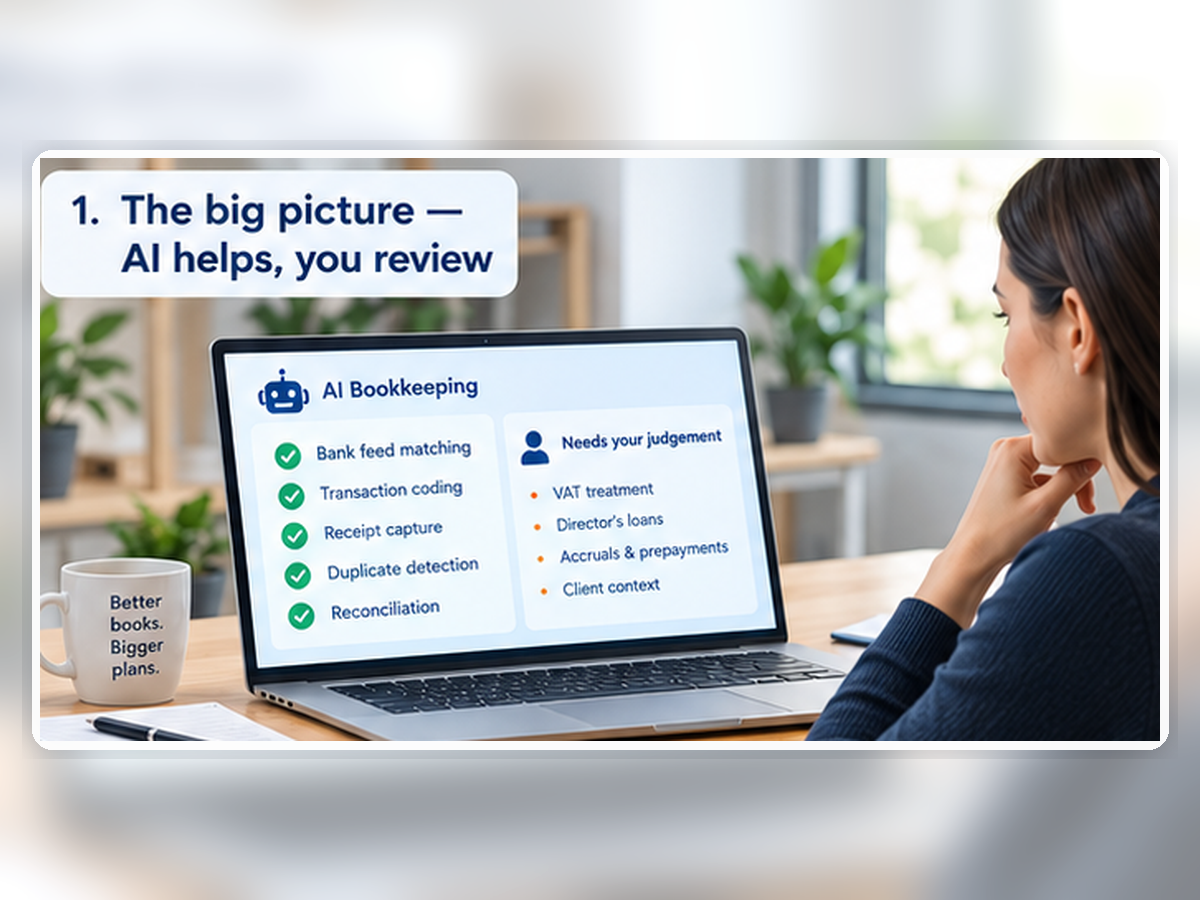
Most transactional bookkeeping, yes: bank feed matching, coding recurring transactions and first-pass reconciliation. VAT edge cases, director’s loan accounts and cut-off still need a person. We set out the split task by task in can AI do bookkeeping?
Where to start
If you take one thing from this, take the question rather than the answer. The question is not whether to adopt AI, because seven in ten UK accountants already have. The question is whether the AI in your firm is touching the work that actually costs you money.
Drafting emails saves minutes. Reviewing files saves evenings.
See how Papercare reviews a file. Book a live demo or start a free trial.
About the author
Written by the Papercare Team. Papercare is the AI accountant for UK accountancy practices: AI accounting software that imports the client’s data, builds AI working papers that tie, and raises review points before the partner opens the file. It was built inside a live UK practice by founder Shrineel Patel FCCA. More about Papercare