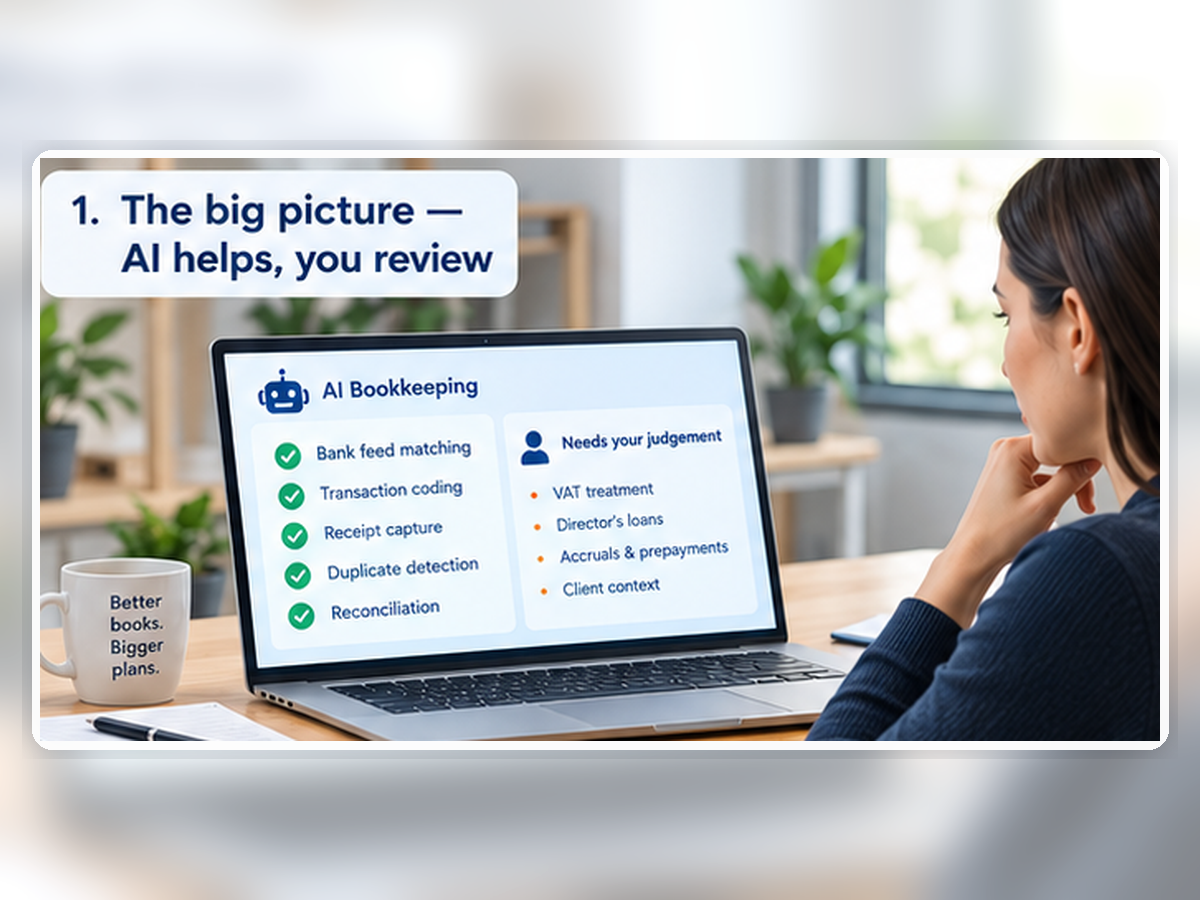

Someone in your firm has already pasted client data into ChatGPT. Not maliciously, and probably not even knowingly: they had a difficult letter to draft, the deadline was that afternoon, and the fastest way to get a first version was to paste in the background and ask for help with the wording.
The AccountingWEB and Sage survey of more than 600 UK members, published in February 2026, found 71% using external AI tools such as ChatGPT, Gemini or Microsoft Copilot, and the most common uses were transcribing meetings, drafting client emails and researching tax rules. Every one of those involves client information. Very few firms have written down what is and is not allowed.
This is a practical guide to fixing that, with a policy you can adapt at the end.
The short answer
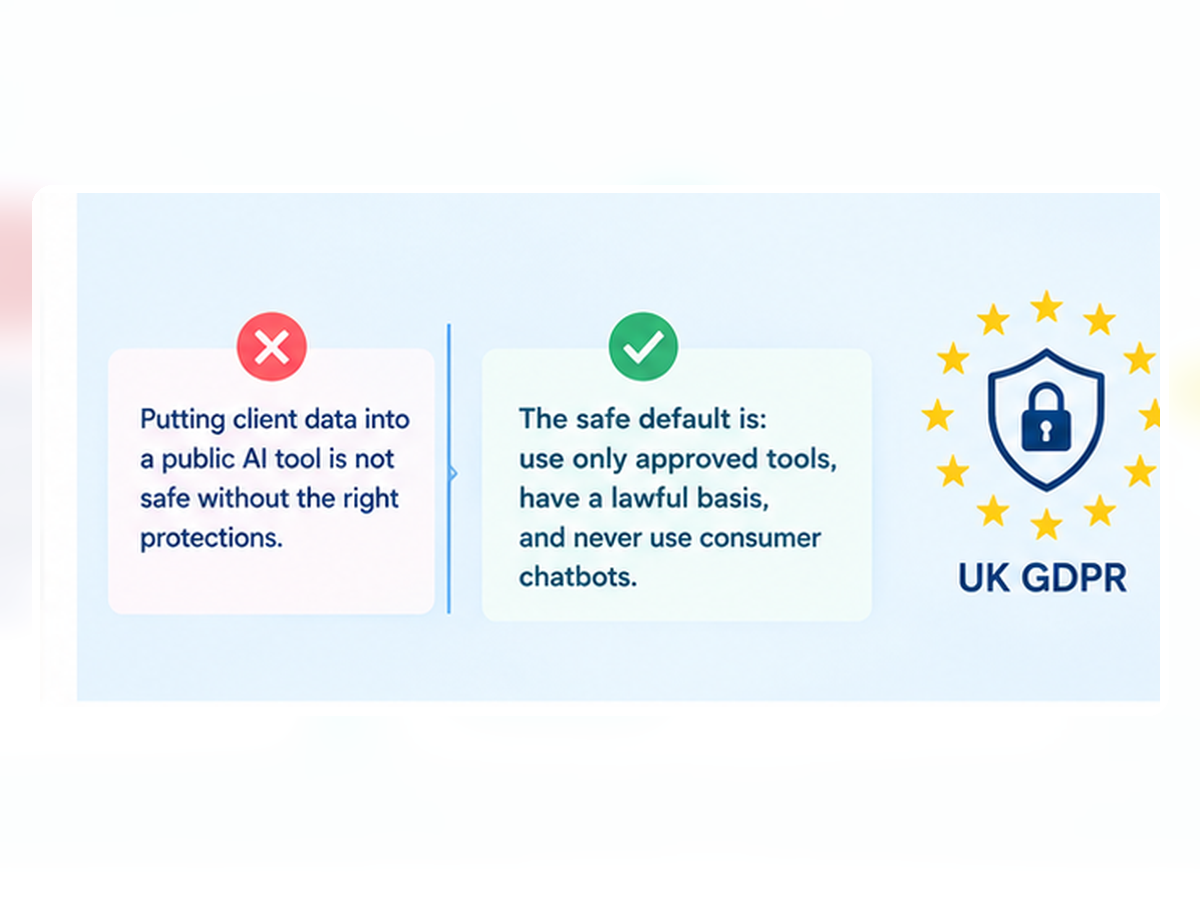
Putting client personal data into a public AI tool is not automatically unlawful under UK GDPR, but it is almost always unwise without a lawful basis, a data processing agreement, and a check on whether the data will be used for training. The safe default for a UK practice is that identifiable client data goes only into tools the firm has contracted with, and never into a consumer chatbot.
The reason is not that regulators have banned it. It is that you cannot demonstrate accountability for something you have not thought about, and accountability is the principle the Information Commissioner’s Office tests first.
What the rules actually are
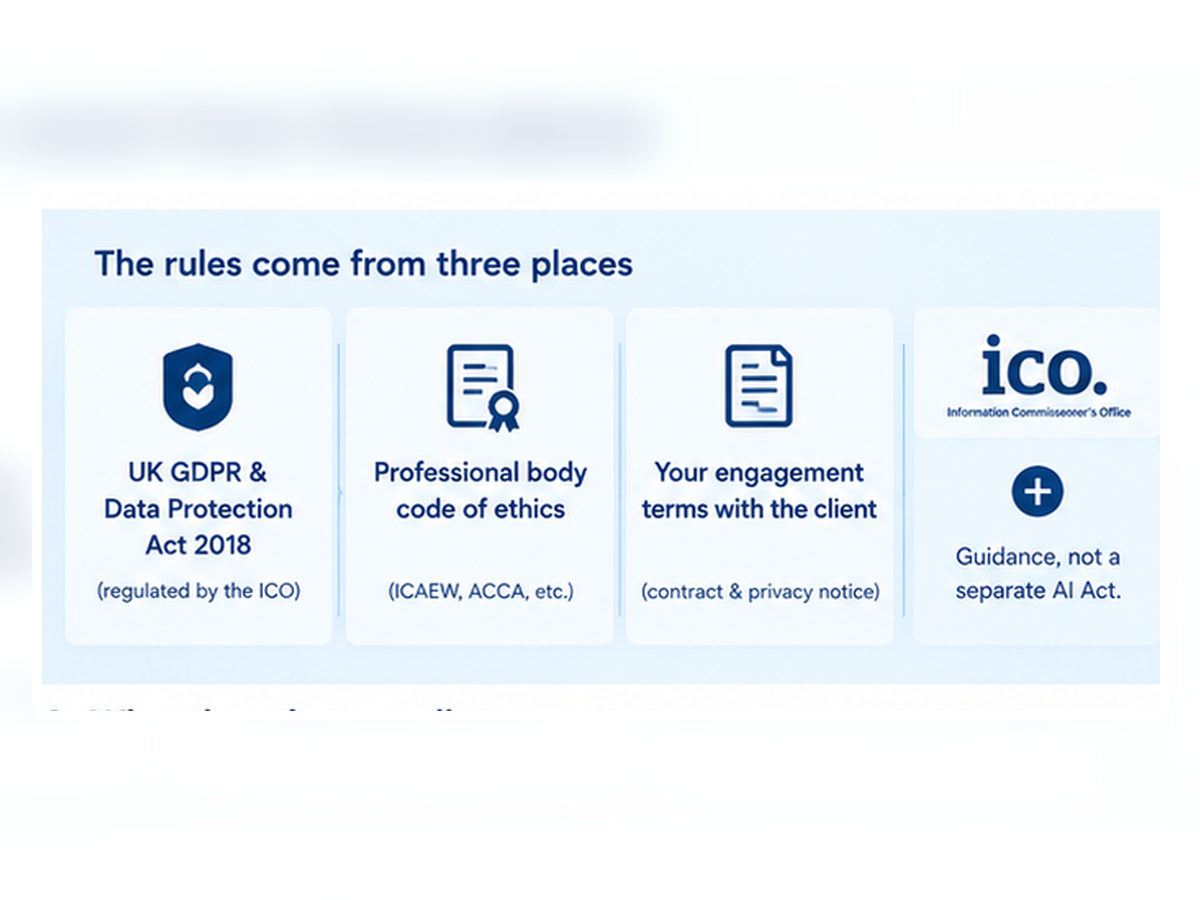
There is no UK AI Act. This surprises people who have followed the EU debate, and it matters for how you approach compliance.
For a UK accountancy practice using AI, the binding obligations come from three places: the UK GDPR and the Data Protection Act 2018, regulated by the ICO; your professional body’s code of ethics; and your engagement terms with the client. There is no separate AI statute sitting above those.
What the ICO expects

The ICO has published dedicated guidance on AI and data protection. It is not a statutory code, but the ICO uses the same framework when it audits and investigates, so treating it as optional is a poor bet. The guidance is currently under review following the Data (Use and Access) Act, which is worth knowing if you are reading it directly.
The requirements that bite hardest for a practice are these.
- Accountability and governance. You must be able to show the decisions you made and why. A Data Protection Impact Assessment is expected where AI processing is likely to result in high risk, and processing client financial data at scale usually qualifies.
- Lawfulness. You need a lawful basis for the processing, and it has to be identified before the processing starts rather than reverse-engineered afterwards.
- Transparency. Clients should be able to find out that AI is used in the service you provide them. This normally belongs in your engagement letter and privacy notice rather than in a separate announcement.
- Accuracy. Statistical accuracy matters, and it connects directly to the professional problem: an AI output that is confidently wrong about a client is a data protection issue as well as a professional one.
- Fairness, including the Article 22 safeguards where a decision is made solely by automated means with legal or similarly significant effects.
What the professional bodies add
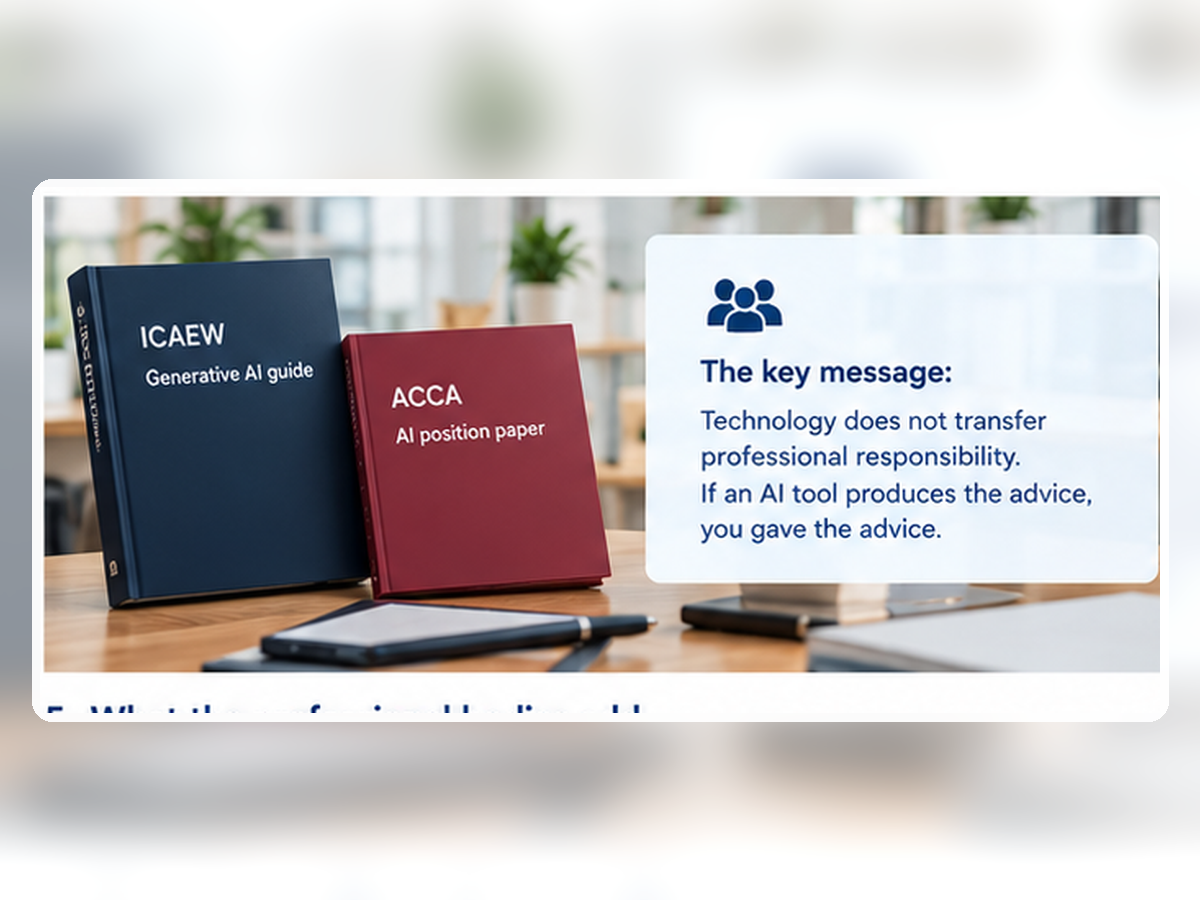
The PCRT bodies issued guidance on the ethical use of artificial intelligence tools in January 2026. ICAEW has published a generative AI guide and ACCA a position paper. The consistent thread across all of them is that technology does not transfer professional responsibility. If an AI tool produces the advice, you gave the advice.
The question that actually decides it
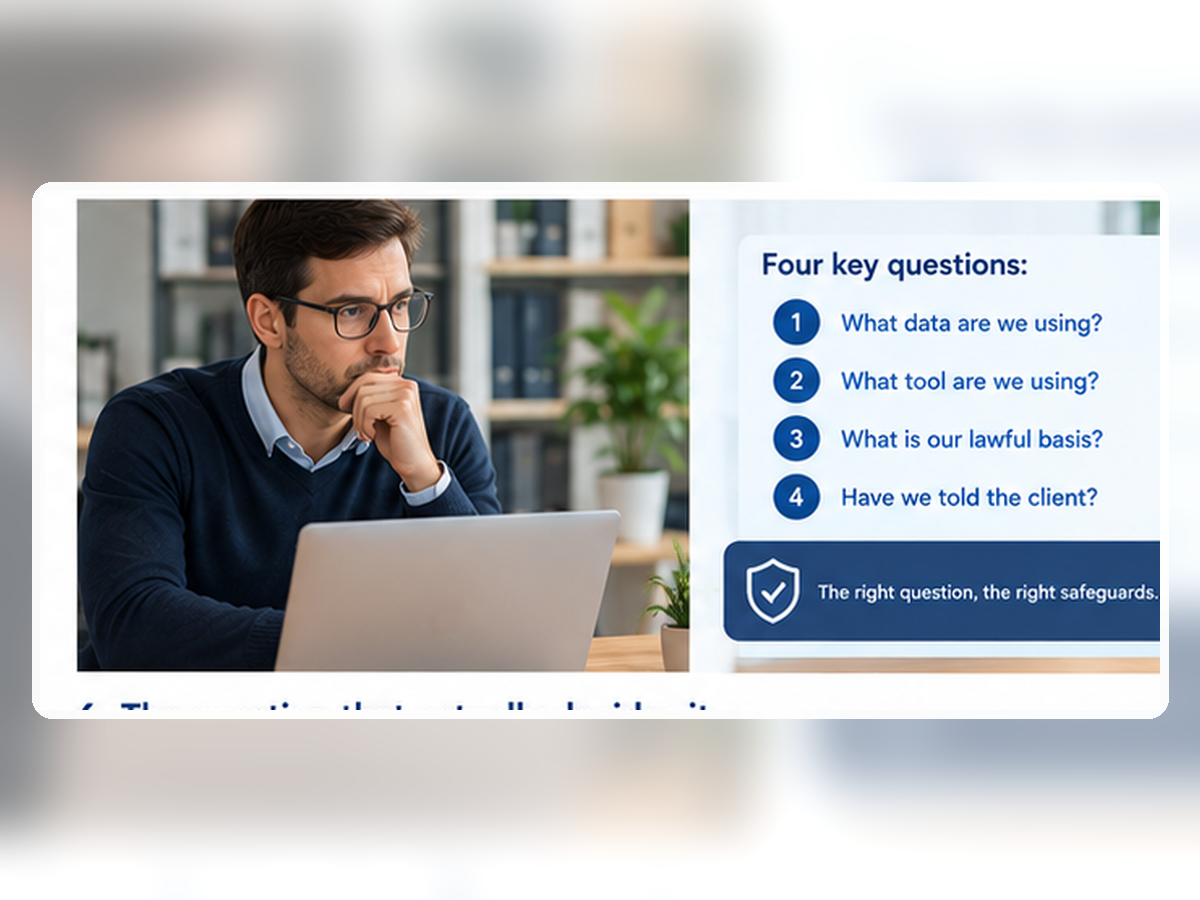
Most of the confusion in practice comes from treating “can we use AI” as one question. It is really four, and they have different answers.
| What you are putting in | Into a consumer chatbot | Into a contracted business tool |
|---|---|---|
| A general technical question with no client details | Acceptable | Acceptable |
| An anonymised scenario with identifying details removed | Usually acceptable, with care | Acceptable |
| Identifiable client information | No | Only with a DPA and a training exclusion |
| Client financial records or documents | No | Only with a DPA, training exclusion and a DPIA |
| Special category data, such as health information in a claim | No | Only with an identified Article 9 condition |
The row people get wrong is the second one. Anonymisation is harder than it looks. Removing a name from a set of accounts for a business with an unusual turnover profile in a small sector does not necessarily stop it being identifiable, and the ICO’s test is whether identification is reasonably likely, not whether you removed the obvious fields.
Six questions to ask any AI vendor
These are the questions that separate a tool you can put near a client file from one you cannot. Ask them in writing, and keep the answers, because that correspondence is part of demonstrating accountability.
- Where is the data hosted, physically? UK hosting is the cleanest answer for a UK practice. EU hosting is workable. Anything else needs a transfer mechanism and a documented assessment.
- Is our data used to train your models, or any third party’s models? You want a contractual no, not a setting you can toggle. Settings change with product updates; contracts do not.
- Is our firm’s data segregated from other customers’ data? Multi-tenant systems can be perfectly safe, but you should know which design you are buying.
- Will you sign a data processing agreement, and what does it say about sub-processors? Most large models are accessed through an intermediary, so the sub-processor chain matters.
- What is your retention period, and can we require deletion? Both for the data and for anything derived from it.
- What happens to our data if you are acquired or cease trading? Rarely asked, occasionally the most important question on the list.
For transparency about our own product: Papercare hosts data in the UK, segregates it by firm, and does not use client data to train models. We would expect you to ask us the other questions too, and to ask for the answers in writing.
A one-page AI policy you can adapt
The most useful thing a practice can do this month is write down what staff may and may not do. Not a twelve-page document nobody reads. One page, on the intranet, referenced in induction. Here is a working draft to adapt.
AI use policy, [Firm name]
1. Approved tools. Staff may use [named tools] for work involving client information. No other AI tool may be used with client information without approval from [named person].
2. Consumer AI tools. Public tools including ChatGPT, Gemini, Claude and Copilot may be used for general research, drafting with no client details, and learning. Client names, financial figures, documents, correspondence and any information that could identify a client must not be entered into them.
3. The test before you paste. If this text appeared on a public website tomorrow, could anyone work out which client it relates to? If yes, it does not go into a public tool.
4. Review of output. All AI output used in client work is checked by the person responsible for the engagement before it is sent, filed or relied upon. AI-generated figures are verified against source documents. Nothing is sent to a client without a person reading it in full.
5. Records. Where AI has materially contributed to advice or a deliverable, note it on the file.
6. Client transparency. Our engagement letter and privacy notice describe our use of AI. Clients who ask may be told which tools we use and what they do.
7. Reporting. If client information has gone into a tool it should not have, tell [named person] the same day. This will not be treated as a disciplinary matter in itself. Concealing it will be.
That last clause is the one most firms leave out and the one that does the most work. Staff who fear consequences do not report mistakes, and an unreported data incident is considerably worse than a reported one.
What good practice looks like in the engagement letter
Transparency does not require a separate conversation with every client. It requires that the information is available and accurate. A short clause covering three points is usually enough: that the firm uses technology including artificial intelligence to assist in delivering services, that all output is reviewed by a qualified person who remains responsible for the work, and that client data is not used to train third-party models.
Have your usual adviser check the wording against your engagement terms. We are not providing legal advice here, and the right clause depends on the services you offer.
The risk nobody puts in the policy
There is a failure mode that no amount of policy writing addresses, and it is worth naming because it is the one that actually causes harm in practice.
The AccountingWEB and Sage research found that the top-ranked concern among UK accountants was not data security. It was accuracy and hallucination, ahead of everything else. Data protection failures are visible and recoverable. A confidently wrong figure that passes through review because it looked plausible ends up in filed accounts, and nobody discovers it until someone asks a question eighteen months later.
A policy that covers only data protection addresses the smaller of the two risks. We have written separately on why AI gets numbers wrong and what a system has to do to stop it.
Frequently asked questions
Is it against GDPR to put client data into ChatGPT?
Not automatically, but in practice it is very difficult to justify. You would need a lawful basis, a data processing agreement with the provider, a check on whether inputs are used for training, and a record of the decision. For most UK practices the simpler and safer position is that identifiable client data goes only into tools the firm has contracted with.
Do we need a DPIA before using AI in our practice?
A Data Protection Impact Assessment is expected where processing is likely to result in high risk to individuals. Processing client financial data at scale through a new AI system usually meets that threshold. The ICO expects AI implications to be considered as part of the DPIA rather than as a separate exercise.
Is there a UK AI Act we need to comply with?
No. As at late 2026 there is no dedicated UK AI statute. The binding rules come from UK GDPR and the Data Protection Act 2018, regulated by the ICO, together with your professional code of ethics and your engagement terms.
Do we have to tell clients we use AI?
The transparency principle means clients should be able to find out. In practice that is handled through the engagement letter and privacy notice rather than a separate disclosure. Being straightforward about it is also commercially sensible, because the alternative is a client discovering it another way.
Is anonymising client data enough to make it safe?
Sometimes, but anonymisation is harder than removing names. The test is whether identification is reasonably likely, and a business with a distinctive turnover profile in a small sector can be identifiable from figures alone. Treat partial redaction as risk reduction rather than as a solution.
What should a firm AI policy actually contain?
Approved tools, a clear rule on consumer chatbots, a simple test staff can apply before pasting anything, a review requirement for all output, a record-keeping line, a client transparency line, and a no-blame reporting route for mistakes. One page is enough.
Where should AI vendors host UK client data?
The UK is the cleanest answer, and the EU is workable. Anywhere else requires a valid transfer mechanism and a documented assessment. Ask for the answer in writing and keep it, because that correspondence forms part of your accountability record.
What to do this week
Three things, in order, and none of them takes long.
Ask your team what they are already using. Not as an audit, as a conversation. You will almost certainly find tools you did not know about, and you cannot write a policy for behaviour you have not mapped.
Write the one-page policy. Adapt the draft above, name a person, and put it where induction can find it.
Send the six vendor questions to whoever supplies your AI-enabled software, including us. Keep the replies. The firms that handle a data question well are the ones that already had the answers written down.
If you want to see what UK hosting, firm-level segregation and a no-training commitment look like in practice, book a live demo. Bring the questions.
About the author
Written by the Papercare team. Papercare is a UK working papers and AI review platform built inside a live UK accountancy practice by founder Shrineel Patel FCCA.