


Introduction
Growth is often seen as a simple equation in accounting firms: more clients require more staff. On the surface, this seems logical. As workload increases, capacity must increase alongside it. However, for many small and mid-sized UK accounting firms, hiring more people does not always solve the underlying problem.
In reality, growth exposes inefficiencies that were previously manageable at a smaller scale. What once worked with a handful of clients begins to break down under increased pressure. Teams become overwhelmed, deadlines start slipping, and profitability begins to tighten despite higher revenue.
The real constraint is not always headcount, it is how work flows through the firm.
This is why a growing number of firms are starting to rethink their approach. Instead of immediately hiring, they are asking a more important question: how can we handle more work with the same team by improving how we operate?
Where Accounting Firm Capacity Is Actually Lost

One of the most common misconceptions is that capacity is limited purely by the number of people in the team. In practice, a significant portion of capacity is lost within the workflow itself.
Time is often consumed by tasks that do not directly contribute to client outcomes. Manual data entry, repeated formatting, searching for files, and resolving inconsistencies which results in spreadsheet inefficiencies all add up. These activities may seem minor individually, but across multiple engagements they create a substantial drain on available time.
Another key issue is fragmentation. When working papers, spreadsheets, and communication are spread across different systems, teams spend more time managing information than actually working with it. This lack of cohesion introduces friction at every stage of the process.
As a result, firms reach a point where they feel “at capacity” even though a large portion of their effort is being spent inefficiently.
Why Hiring More Staff Often Fails to Solve the Problem

Hiring is often treated as the default solution to growth. While it can provide short-term relief, it does not address the structural issues within the workflow.
When new team members join, they enter an existing system. If that system is inefficient, the inefficiencies scale alongside the team. More people means more coordination, more communication, and often more inconsistency in how work is performed.
In addition, onboarding takes time. New hires need to understand existing processes, which may already lack standardisation. This slows down productivity in the short term and adds pressure to existing team members.
Over time, firms can find themselves in a cycle where increasing headcount leads to increasing complexity rather than increased efficiency. The problem shifts from “not enough people” to “too much operational friction.”
The Role of Working Papers in Capacity Constraints

Working papers sit at the centre of accounting workflows, particularly in audit and compliance work. They are the foundation upon which documentation, review, and final outputs are built.
However, in many firms, working papers are also one of the biggest sources of inefficiency. When they are managed through spreadsheets and disconnected files, they become difficult to maintain, review, and standardise.
This creates delays that ripple through the entire workflow. Preparation takes longer, reviews become more time-consuming, and errors are more likely to occur. Each of these factors reduces the firm’s ability to handle additional work.
Improving how working papers are structured and managed is therefore one of the most effective ways to unlock capacity within an existing team.
How Modern Firms Increase Capacity Without Hiring

Firms that successfully scale without increasing headcount approach the problem differently. Instead of focusing on adding resources, they focus on improving how work is done.
The first step is reducing manual dependency. By minimising repetitive tasks and structuring how data is handled, firms can free up a significant amount of time. This allows teams to focus on higher-value work rather than routine activities.
The second step is standardisation. When workflows are consistent across engagements, work becomes more predictable and easier to manage. This reduces variability and makes it easier for teams to operate efficiently.
The third step is improving collaboration. When teams can work within a shared system with real-time updates, the need for back-and-forth communication decreases. This accelerates progress and reduces delays.
Finally, visibility plays a crucial role. When managers and partners have a clear view of progress and bottlenecks, they can make proactive decisions rather than reacting to issues after they arise.
The Shift Towards Systems That Enable Scale

As firms grow, the limitations of traditional tools become more apparent. Spreadsheets and manual processes can only scale to a certain point before they start creating more problems than they solve.
This is why many firms are moving towards systems designed specifically for accounting workflows. These systems provide structure, consistency, and visibility in a way that generic tools cannot.
By centralising working papers, standardising processes, and enabling real-time collaboration, these platforms remove much of the friction that limits capacity.
The result is a workflow that can handle increased volume without a proportional increase in effort.
Where Papercare Fits Into This Shift

Platforms like Papercare are built around this exact need: helping firms scale their operations without increasing complexity.
Rather than adding another tool to the stack, Papercare provides a structured environment where working papers, workflows, and collaboration come together in one place. This reduces fragmentation and allows teams to operate more efficiently.
By standardising how work is done and improving visibility across engagements, it enables firms to handle more clients without placing additional pressure on their teams.
The value is not just in saving time, but in creating a system that supports sustainable growth.
What This Looks Like in Practice
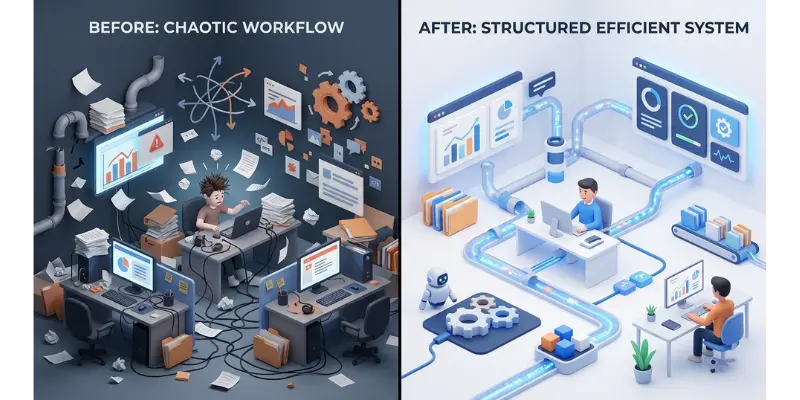
When firms implement structured workflows and better systems, the impact is noticeable.
Teams spend less time on repetitive tasks and more time on meaningful work. Reviews become faster because documentation is consistent and easy to follow. Managers gain better visibility into progress, allowing them to allocate resources more effectively.
Most importantly, firms are able to take on additional clients without immediately needing to expand their team. Growth becomes manageable rather than overwhelming.
This shift does not happen overnight, but the long-term benefits are significant.
Conclusion

The assumption that growth requires more people is deeply ingrained in many accounting firms. However, as workflows become more complex, this approach becomes increasingly unsustainable.
Capacity is not just a function of headcount, it is a function of how efficiently work is performed.
Firms that focus on reducing manual work, improving structure, and adopting systems designed for their workflows are able to unlock capacity that already exists within their teams.
In a competitive and demanding environment, this ability to scale efficiently is no longer optional. It is what separates firms that struggle under growth from those that thrive because of it.