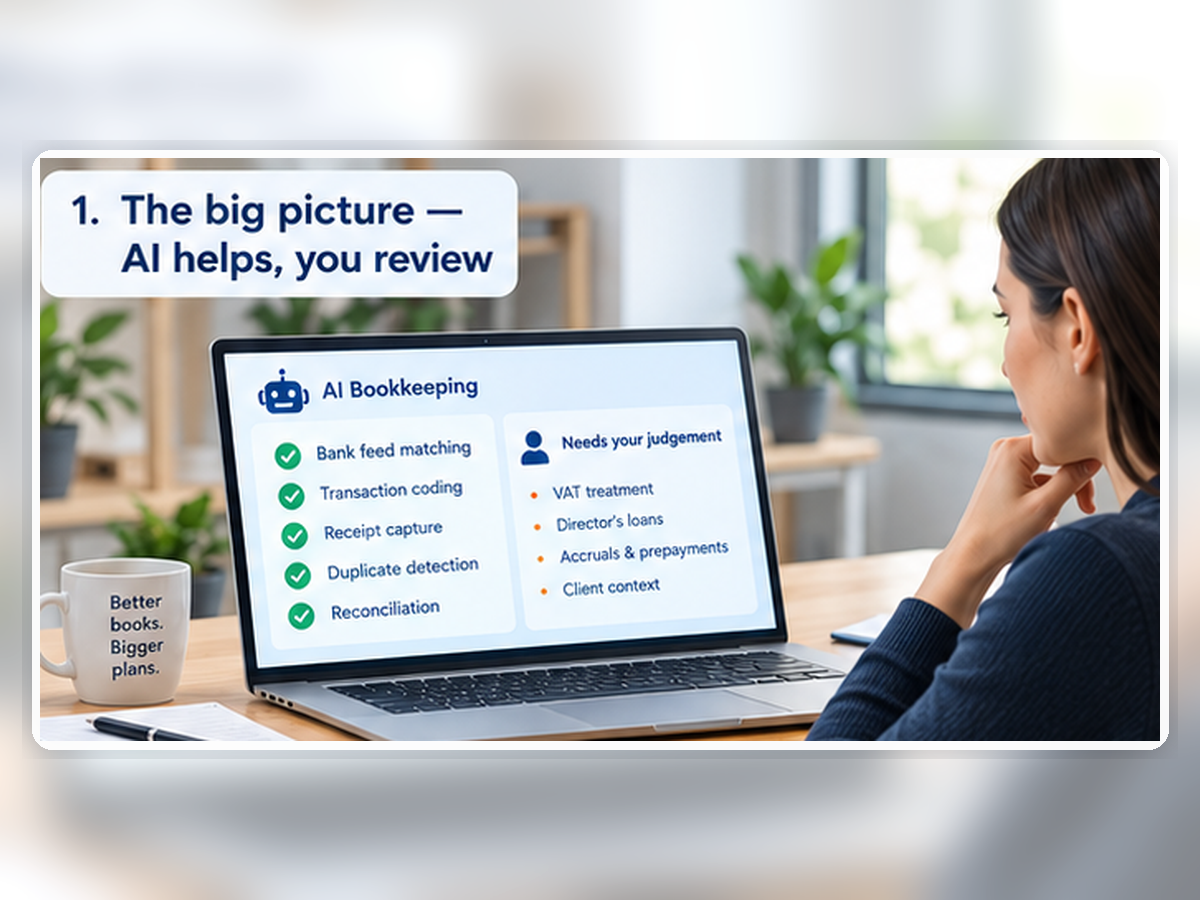
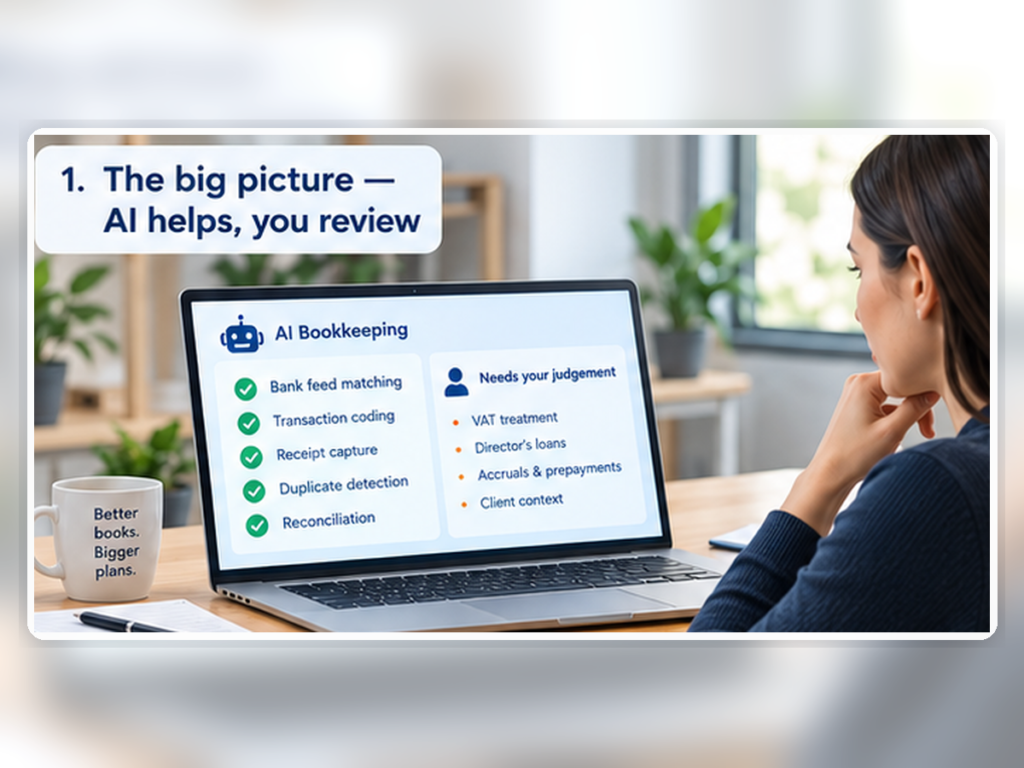
AI does bookkeeping well right up to the point where the answer depends on something the ledger does not know. It will code a Screwfix payment to repairs without hesitation. It cannot tell you whether that particular £4,200 of work was a repair or a capital improvement, because the answer is in a conversation with the client about what was actually done to the roof.
That line, between processing and judgement, is where the honest answer to this question lives. Most of what has traditionally been called bookkeeping now sits on the automated side of it. A meaningful and stubborn remainder does not, and it happens to be the part where the mistakes are expensive.
The short answer
AI can now handle most transactional bookkeeping: bank feed matching, transaction coding, receipt capture, duplicate detection and routine reconciliation. It cannot reliably handle VAT treatment on edge cases, director’s loan accounts, accruals and prepayments requiring judgement, or anything that depends on knowing what the client actually did.
The practical consequence for a UK practice is not that bookkeeping disappears. It is that the job changes shape. The hours move out of data entry and into review, exception handling and the client conversations that resolve the things software cannot.
What AI genuinely does well now
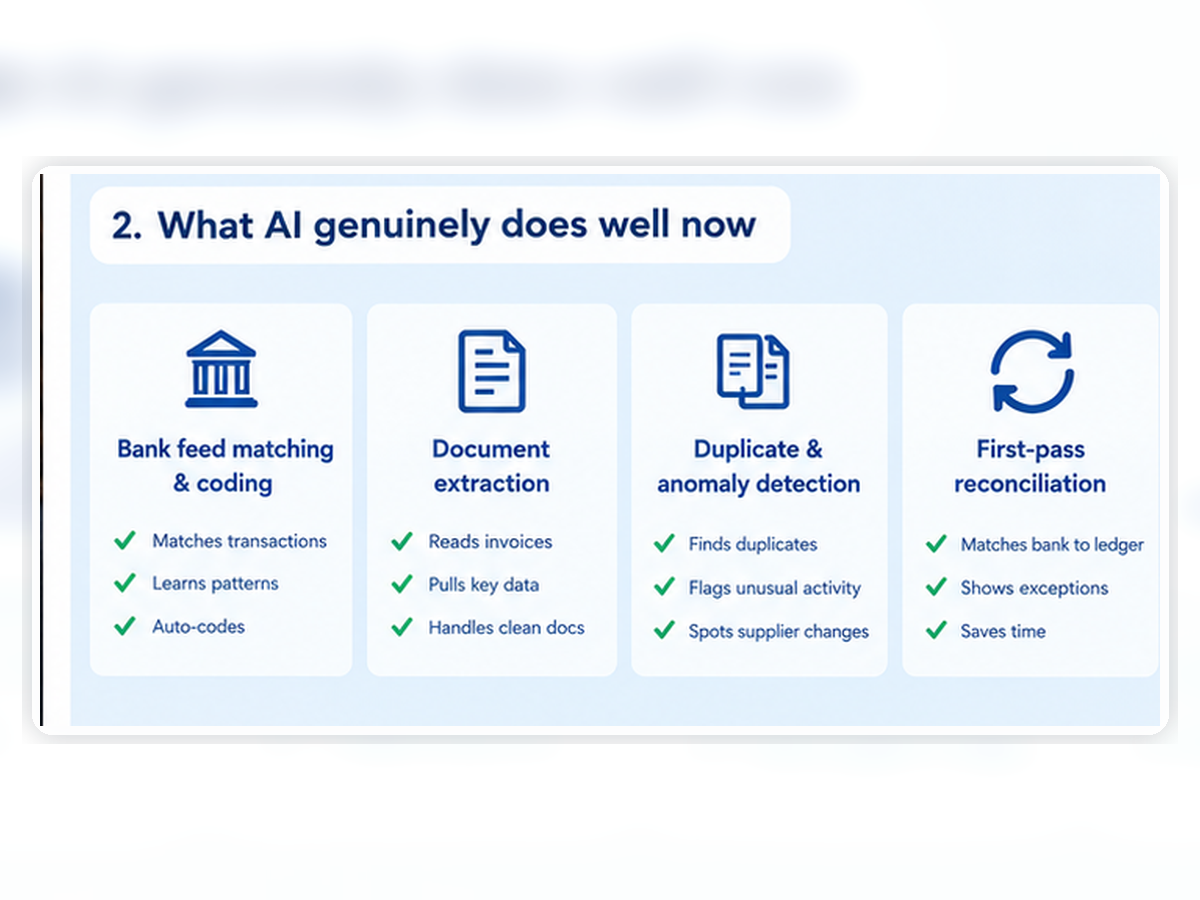
Four things have moved from difficult to routine over the past three years, and it is worth being precise about them because the marketing in this space blurs everything together.
Bank feed matching and transaction coding
Pattern recognition against a client’s own history is what machine learning was built for. After a few months of data, a system that sees a monthly payment to the same supplier for a similar amount will code it correctly without being asked. Accuracy on recurring, unambiguous transactions is high enough that reviewing every line individually is no longer a good use of anyone’s time.
The AccountingWEB and Sage survey of more than 600 UK members, published in February 2026, found 45% of respondents already using AI or machine learning to automate repetitive tasks such as invoice processing and bank reconciliation. This is the most widely adopted category of AI in UK practice, and it has been quietly working for years under the name machine learning before anyone rebranded it.
Document extraction
Reading a supplier invoice and pulling out the date, net, VAT, gross and supplier name is now largely solved for clean documents. The same survey found 39% of firms using AI-powered document processing. Where it still struggles is the photograph of a crumpled receipt taken at an angle in a dark van, which is unfortunately a meaningful share of the source documents a small practice actually receives.
Duplicate and anomaly detection
Finding the invoice entered twice, the payment that does not match anything, the supplier who has suddenly changed bank details, the expense category that has jumped 40% on last year. This is straightforward pattern work and software does it faster and more consistently than a person reading down a list at four in the afternoon.
First-pass reconciliation
Matching the bank to the ledger and presenting what did not match. The matching is automated; the exceptions are where the work is. That split is the whole story of AI bookkeeping in one sentence.
Where it still gets things wrong
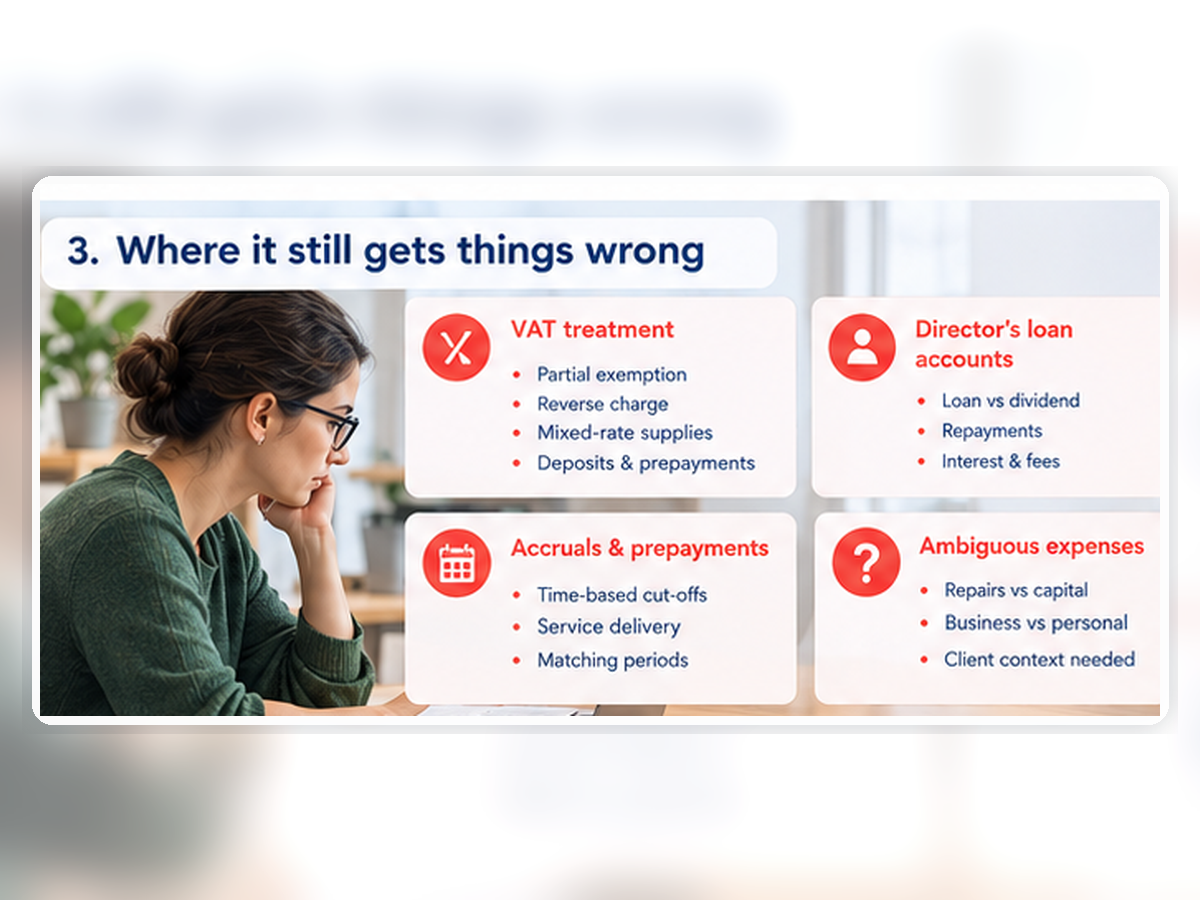
This is the section most vendor pages leave out, which is exactly why it is worth reading. Each of these is a real failure mode, not a theoretical one.
VAT treatment on anything unusual
Standard-rated supplies are easy. The problems start with partial exemption, the reverse charge in construction, mixed-rate supplies, the distinction between a business entertainment cost and a staff welfare cost, and the treatment of a deposit that may or may not be consideration. A model will produce a confident VAT code for all of these. Its confidence carries no information about whether the code is right.
There is a policy angle here worth knowing. Writing in AccountingWEB in September 2026, technology editor Tom Herbert pointed out that HMRC checks whether Making Tax Digital products connect securely, but does not check whether they categorise data correctly, unlike certification regimes in the United States and Canada. So the software passing HMRC recognition tells you nothing about whether its coding is accurate.
Director’s loan accounts
The single most reliable source of AI bookkeeping errors in an owner-managed business. A payment from the company account to a builder working on the director’s house looks exactly like a repair to any system reading the transaction alone. Getting it right requires knowing whose house it was, which is not in the data.
Accruals, prepayments and cut-off
Anything requiring a decision about which period a cost belongs to needs someone who understands the underlying arrangement. Software can flag that an invoice dated 3 April relates to services delivered in March. It cannot decide what to do about a twelve-month insurance policy paid in November without being told the policy dates.
Anything the client got wrong
If the client has posted a personal holiday to travel expenses, a well-trained system will learn from that error and keep making it. Automation is very good at scaling whatever it is shown, including mistakes. This is why the review layer matters more, not less, as the coding layer improves.
The practical check here is a misposting review run across every P&L code before the accounts are prepared. It finds entries booked to the wrong account and reclassifies them in bulk with an automated journal.
The honest split, task by task
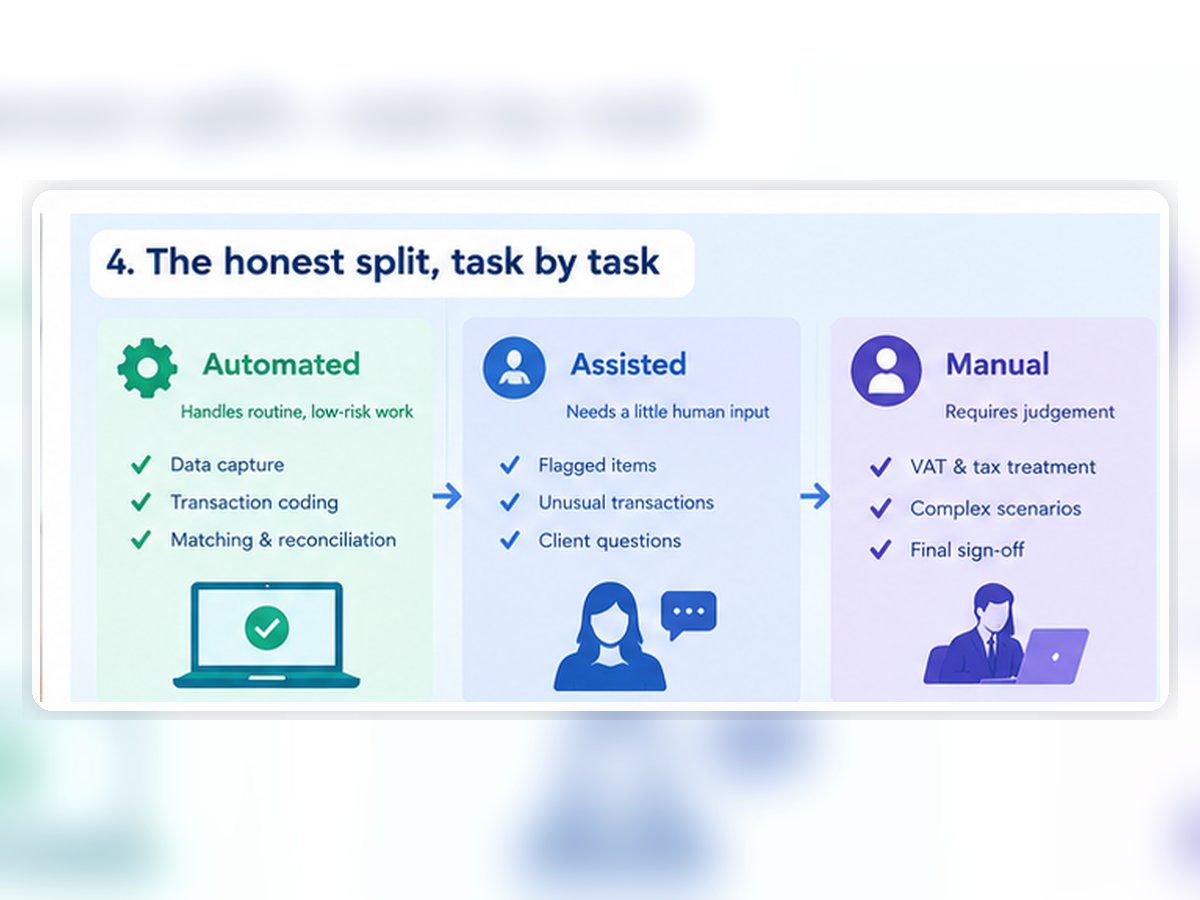
Here is how the work actually divides in a UK practice today. The middle column is the one that matters, because assisted work is where most of the confusion about AI bookkeeping comes from: the software does something real, and a person still has to finish it.
| Task | Status | What still needs a person |
|---|---|---|
| Bank feed import | Automated | Nothing, once connected |
| Coding recurring transactions | Automated | Spot checks and new supplier types |
| Receipt and invoice extraction | Automated | Poor-quality images and unusual layouts |
| Duplicate detection | Automated | Deciding which of the two entries to keep |
| Bank reconciliation | Assisted | Every unmatched item |
| VAT coding | Assisted | Edge cases, partial exemption, reverse charge |
| Expense categorisation | Assisted | Anything ambiguous or personal |
| Accruals and prepayments | Assisted | The judgement on period and amount |
| Director’s loan account | Manual | Almost all of it |
| Cut-off decisions | Manual | All of it |
| Client queries | Manual | All of it |
| Final review before accounts | Manual | All of it |
Count the rows and the picture is clear enough. Roughly a third of the work is genuinely automated, a third is assisted and still needs finishing, and a third has barely moved. Any vendor describing the whole table as solved is describing a product that does not exist.
What this means for how a practice is staffed
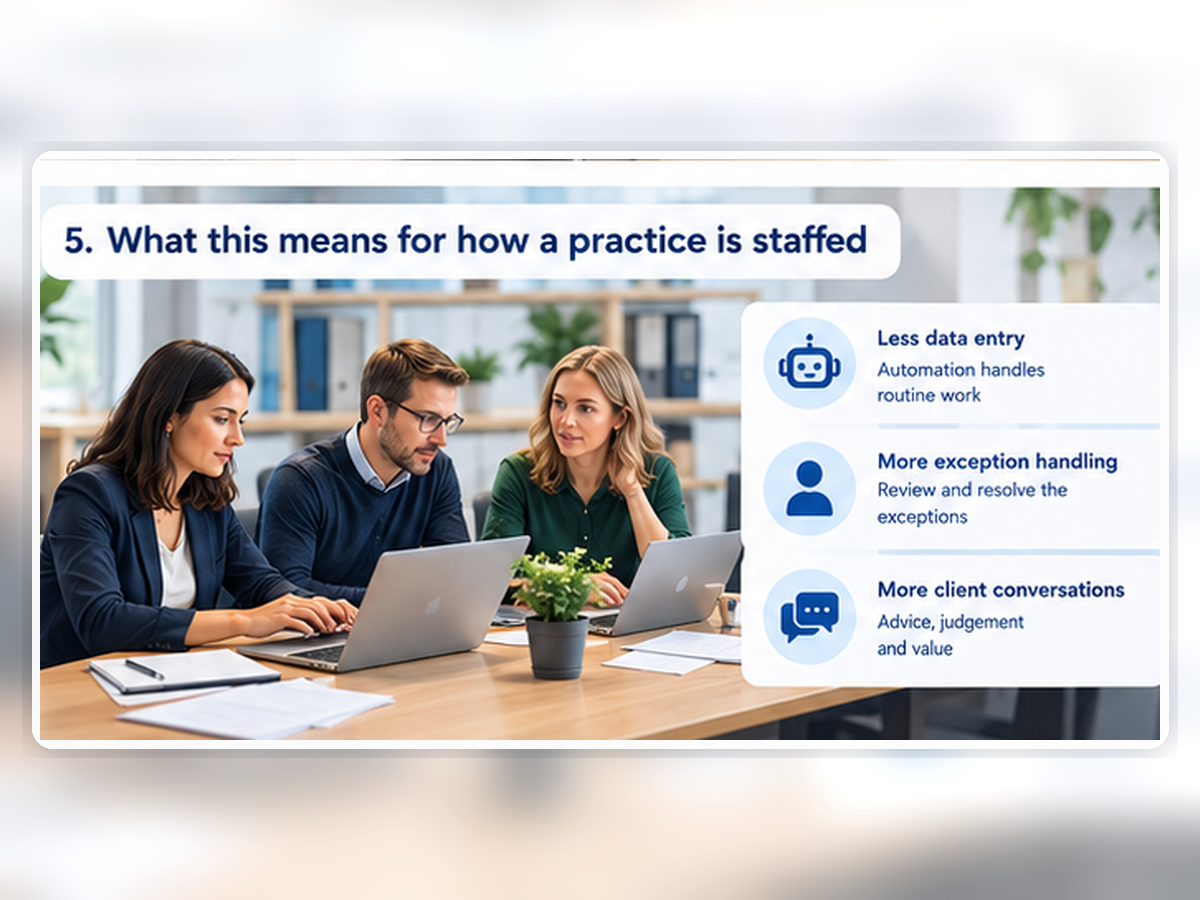
The interesting consequence is not cost saving. It is that the shape of a bookkeeping job has inverted.
The traditional pattern was a junior spending most of the week entering and coding, with a senior reviewing at the end. The emerging pattern is software doing the entering and coding, and a person spending the week on exceptions, queries and judgement. That is a harder job, not an easier one, and it requires more technical knowledge rather than less.
This is the gap an AI accountant is built for. AI bookkeeping software codes the transactions. An AI accountant reviews the whole file once the coding is done. Our guide to what an AI accountant is draws that line in detail.
ICAEW research published in May 2026, based on interviews with 35 mid-tier managing partners and chief executives, found 68% expecting AI to reduce demand for some early-career roles while 83% said it would not reduce overall headcount. Read alongside the task table above, that makes sense. The processing work is going. The exception work is growing, because the volume of transactions flowing through practices keeps rising as Making Tax Digital pulls more clients into quarterly reporting.
We have written separately on what that means for the profession as a whole.
The MTD pressure that makes this urgent
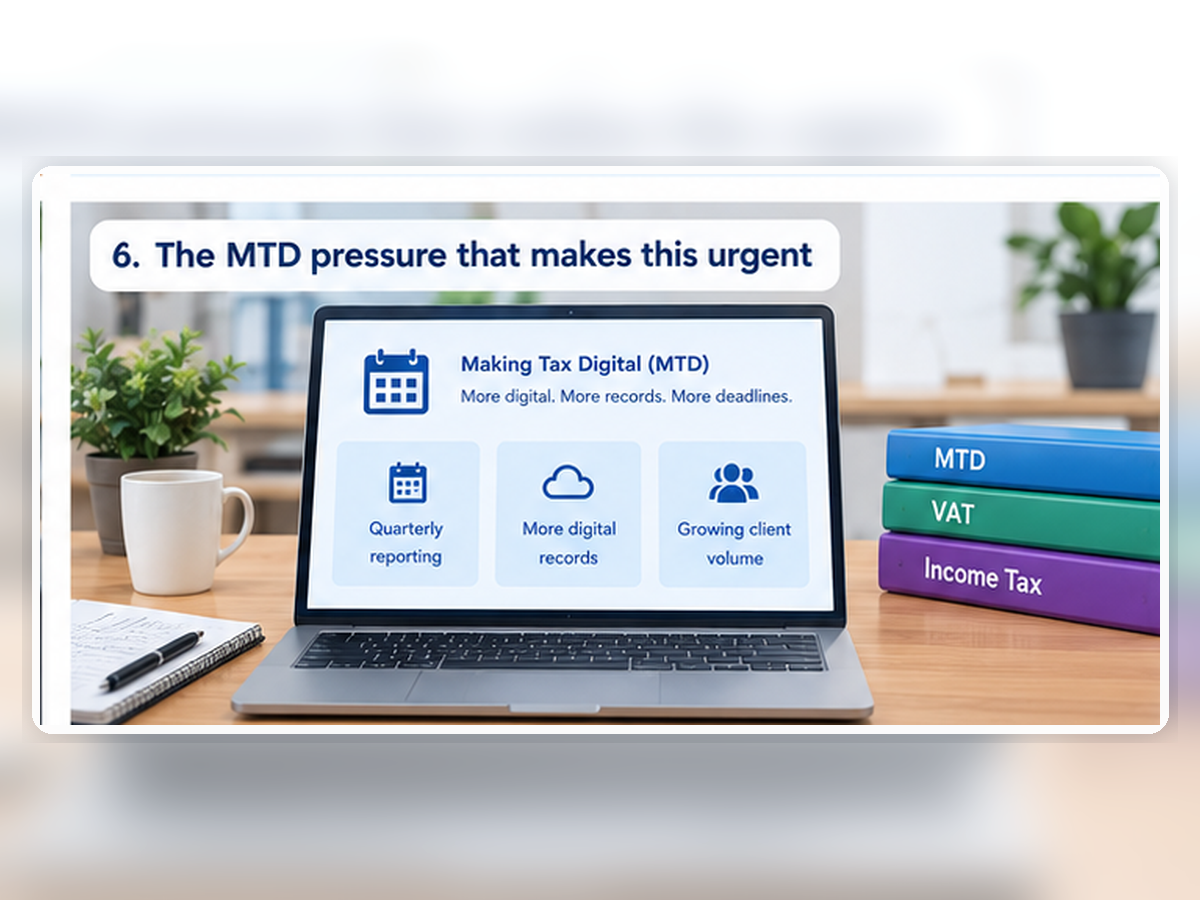
Bookkeeping quality used to be an annual problem. It is becoming a quarterly one, which changes the economics of getting it right.
Making Tax Digital for Income Tax went live on 6 April 2026 for sole traders and landlords with qualifying income above £50,000. The threshold drops to £30,000 from April 2027 and £20,000 from April 2028. Each wave converts clients who needed one annual conversation into clients who need four.
The 2027 cohort is the one to plan for. The Association of Taxation Technicians has estimated it at roughly 1.077 million taxpayers, of whom only 63% have an agent and 49% use software, against 75% and 63% respectively in the 2026 cohort. A larger, less prepared, less digitised group is arriving, and their bookkeeping will be worse on average than what practices are handling now.
Automating the coding layer without strengthening the review layer will produce four times as many quarterly submissions built on the same unexamined data. Our guide to preparing for MTD for Income Tax covers the operational side of that.
How to evaluate an AI bookkeeping tool
Six questions, in the order we would ask them. The first two separate serious products from repackaged ones quickly.
- What happens to a transaction it is unsure about? The right answer is that it flags it and stops. A tool that codes everything with equal confidence is telling you it has no concept of uncertainty, which is the single most dangerous property a bookkeeping system can have.
- Show me the VAT logic on a reverse charge construction invoice. Specific, UK-only, and the kind of thing a general-purpose tool built elsewhere gets wrong.
- How does it learn from corrections, and can a wrong correction be unlearned? Systems that learn from user behaviour will happily learn an error.
- Which ledgers connect directly, and which need an export? These are not the same amount of work, and vendors often describe both as an integration.
- Where is client data hosted, and is it used to train models? UK hosting and a contractual commitment against training is the baseline for a practice handling client data.
- What does the output look like when a source document is missing? A system that produces a figure anyway is guessing. That matters far more in bookkeeping than people assume, because the guess flows straight into the accounts.
On the fourth question, we should be specific about our own product rather than vague. Papercare connects to QuickBooks Online directly over its API. Xero comes in as a general ledger export in Excel or CSV, with no reformatting required. Excel files are supported for clients who are not on a cloud ledger. Those are three genuinely different routes and it is worth knowing which applies to your client base before you commit to anything.
The Seamless Import page sets out how each route works.
Frequently asked questions
Can AI do bookkeeping on its own?
It can complete most transactional bookkeeping without help, including bank feed matching, coding recurring transactions, extracting data from invoices and flagging duplicates. It cannot complete a set of books on its own, because VAT edge cases, director’s loan accounts, cut-off decisions and anything requiring knowledge of what the client actually did still need a person.
Will AI replace bookkeepers?
Traditional data-entry bookkeeping is the most exposed role in the profession, and much of it has already gone. Bookkeepers who move into exception handling, VAT judgement, client queries and review are moving towards work that is growing rather than shrinking, partly because Making Tax Digital is increasing the volume of periodic reporting.
Is AI bookkeeping accurate enough for HMRC submissions?
On routine transactions, generally yes. On VAT treatment of anything unusual, not without review. It is worth knowing that HMRC checks whether Making Tax Digital software connects securely, but does not certify that it categorises data correctly, so recognition by HMRC is not a statement about coding accuracy.
How accurate is AI transaction coding?
High on recurring transactions with consistent history, and much lower on anything new, ambiguous or unusual. The useful question is not the headline accuracy rate but whether the system tells you which category a given transaction falls into. A tool that flags its own uncertainty is more useful than a tool with a higher average that hides it.
Does AI bookkeeping work with Xero and QuickBooks?
It depends on the tool, and the two are not equivalent. Some products connect to QuickBooks Online directly over its API while taking Xero data as a general ledger export. Ask specifically which of your clients’ ledgers connect directly and which need an export, because the difference is real work.
Is bookkeeping AI-proof?
Data entry is not. Judgement, client relationships and responsibility for what is filed are. The roles most exposed are those built purely on processing volume, which is also where UK practices have struggled hardest to recruit for the last decade.
What is the biggest risk of automated bookkeeping?
Scale. A person miscoding transactions makes a handful of errors. A system miscoding transactions makes the same error consistently across every client it touches until someone notices. The review layer becomes more important as the coding layer improves, not less.
Is AI bookkeeping software the same as an AI accountant?
No. AI bookkeeping software works one transaction at a time: matching, coding and extracting. An AI accountant works on the whole file, comparing the ledger, trial balance, prior year and documents, and raising review points a senior would recognise.
Where to start
If your practice is still coding transactions by hand, automate that layer. The technology is mature, the accuracy on routine work is good, and the time saving is real and measurable.
Then spend some of the time you free up on the exception layer, because that is where the errors now concentrate. The failure pattern we see most often is a firm that automates coding, celebrates the hours saved, reduces review time in proportion, and discovers eighteen months later that a consistent VAT error has been replicating quietly across forty clients.
Bookkeeping automation makes the preparation cheap. It makes the review more valuable, not less.
See how Papercare reviews a file rather than just coding it. Book a live demo or start a free trial.
About the author
Written by the Papercare team. Papercare is a UK working papers and AI review platform built inside a live UK accountancy practice by founder Shrineel Patel FCCA