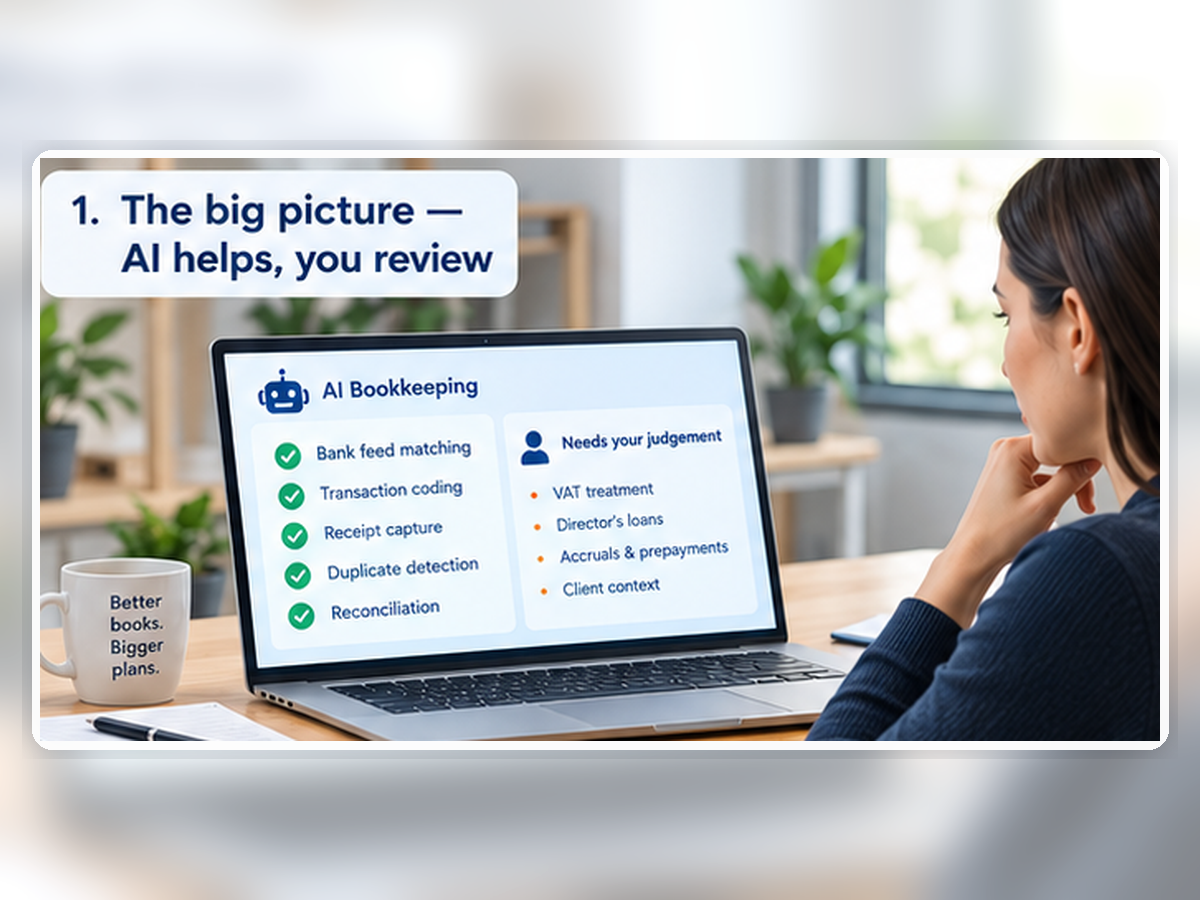

No. AI will not replace accountants, and the people telling you otherwise are usually selling something or writing headlines. But that answer is too comfortable on its own, because AI is already replacing specific accounting tasks, and some roles are built almost entirely from those tasks. The useful question is not whether the profession survives. It is which parts of the job are changing, how quickly, and what that means if you are a partner, a trainee, or deciding whether to start an accountancy degree this year.
This piece gives the honest version, with UK evidence and dates.
The short answer
AI is not replacing accountants. It is replacing the routine preparation work that junior accountants have traditionally done, which changes how people enter the profession far more than whether the profession exists.
ICAEW research published in May 2026 found that while 68% of mid-tier UK firms expect AI to reduce demand for some early-career roles, 83% said it would not reduce their overall headcount.
Both halves of that sentence matter. Demand for early-career routine work is falling. Total employment is not.
When will AI replace accountants? A realistic timeline

This is the question people actually search, usually attached to a year, so here is a straight attempt at it.
Now to 2028. Routine preparation continues to shift to software: bank reconciliation, transaction coding, document extraction, first-pass anomaly detection, drafting. Firms absorb this as capacity relief rather than redundancy, because the compliance burden is rising at the same time. Making Tax Digital thresholds drop to £30,000 in April 2027 and £20,000 in April 2028, which adds clients and quarterly touchpoints rather than removing them.
2028 to 2032. The structural change lands on the training pipeline rather than on qualified staff. ICAEW forecasts the accountant’s role pivoting from routine compliance and reporting towards judgement, interpretation and ethical oversight by 2030. Firms that have not redesigned how juniors learn will start to feel it, because the tasks people used to learn on are the tasks being automated.
Beyond 2032. Honest answer: nobody knows, and anyone giving you a confident figure for 2040 or 2060 is guessing. What is reasonably predictable is the direction, not the date. The parts of the job that involve taking responsibility for a judgement in front of a client or a regulator are the parts that resist automation longest, because the barrier there is accountability rather than capability.
If you want the single most useful frame: exposure is not replacement. A UK government assessment in January 2026, drawing on IMF estimates, put around 70% of UK workers in occupations containing tasks AI could perform or enhance. Accountants sit high on that list. But “contains tasks AI can affect” and “about to disappear” are very different statements, and most alarming headlines quietly swap one for the other.
Which accounting roles are actually exposed

“Accountants” covers a dozen jobs with very different risk profiles. Treating them as one group is why so much of the coverage on this is useless.
Role | Exposure | Why |
Bookkeeping and data entry | Highest | Almost entirely rules-based processing, already heavily automated |
Accounts payable and clerical finance | High | Matching, coding and exception handling are exactly what the technology does well |
Junior and entry-level preparation | High, but reshaped | The tasks go, the training need does not |
Audit associates | Moderate to high | Sampling, testing and exception analysis accelerate sharply, though sign-off does not |
Management accountants | Moderate | Reporting automates, business partnering does not |
Tax advisers | Lower | Research and drafting compress, but interpretation and client-specific positions remain judgement work |
Chartered accountants in practice | Lowest | The role is built on responsibility, judgement and relationships, none of which transfer |
Advisory, forensic and insolvency | Lowest | Adversarial, contested and highly situational work |
The pattern is consistent. Work defined by volume and rules is exposed. Work defined by responsibility and interpretation is not. If your day is mostly processing, that is the honest signal to act on, and the practical response is to move up the file rather than to leave the profession.
Bookkeeping sits at the top of that table for a reason. We break down which bookkeeping tasks AI handles and which still need a person in can AI do bookkeeping?
What is really happening to entry-level accounting jobs

This is where the change is visible right now, and it is more interesting than “AI took the jobs”.
ICAEW’s research with mid-tier firm leaders found a significant reshaping of trainee recruitment: a projected 40% fall in graduate hiring, offset by a 49% rise in school leaver recruitment. Firms are not hiring fewer trainees. They are hiring different ones, through different routes, and earlier.
Several forces are pushing the same way, and it is worth being clear that AI is only one of them. Employer national insurance increases, changes to Level 7 apprenticeship funding and employment rights legislation all feed into the same decision. Attributing the entire shift to AI is the mistake most commentary makes.
The genuine risk in all this is not unemployment. It is a training gap. Junior accountants have always learned judgement by doing the routine work badly at first and being corrected. Automate the routine work without redesigning how people learn, and you get a cohort that can review outputs without ever having built the instinct to know when something is wrong. ICAEW has flagged exactly this: juniors are now expected to review technology-generated information, catch anomalies and push back on automated results.
That is a much harder skill to teach than bookkeeping, and it is the real workforce problem in front of the profession.
Why AI will not replace accountants: four things that do not transfer
The reason the profession is durable is not that AI is weak. It is that four things sit outside what software can hold.
Professional responsibility. Sign-off requires a person who can be held accountable by ICAEW, ACCA, AAT or a court. There is no mechanism by which a model takes that on, and there is no sign of one being built. The PCRT bodies issued guidance on the ethical use of AI tools in January 2026, and it is consistent with everything before it. Technology does not transfer accountability.
Commercial judgement. Whether a client’s expansion plan is sensible, whether a valuation assumption is defensible, whether the director in front of you is being straight. None of it is in the ledger.
The relationship. Conversations about fees, going concern, a family business succession or a mistake your firm made are not drafting problems. Clients pay for someone to sit opposite them and take a position.
Novel judgement. Unusual transactions, first-instance interpretations, anything where the right answer is genuinely arguable. Models are strongest where precedent is dense and weakest exactly where the fee is highest.
For the longer version of this argument, and where the line falls between AI features and genuine capability, see our guide to what an AI accountant actually is.
The gap nobody mentions: adoption is high, impact is low
There is a strange contradiction in the data that undercuts most of the panic.
AccountingWEB, working with Sage, surveyed more than 600 members for its February 2026 report. It found 71% already using external AI tools such as ChatGPT, Gemini or Copilot, and 45% using AI to automate repetitive work. So adoption is widespread.
Then: 53% report only minimal or moderate benefit, and just 7% describe the impact as transformational.
A profession being replaced by a technology does not look like that. Seven in ten using it, one in fourteen finding it transformational, is a profession that has bought the tools and not yet changed the work. The bottleneck is not model capability. It is that most firms have applied AI to the cheap part of the job, which is preparation, and left the expensive part, which is review, largely untouched.
Our piece on whether UK firms are genuinely ready for AI goes into why that gap persists.
What to do about it
Different answers depending on where you sit.
If you run a practice. Redesign how juniors learn before the routine work disappears from under them, because that pipeline problem arrives quietly and is expensive to fix late. Measure partner review hours per file rather than total hours saved, since review is where the cost actually sits. And be specific with clients about what is automated and what a person checks, because that conversation is coming whether or not you start it.
In practice that usually means pointing AI at review rather than preparation: an AI accountant that raises review points on the file, working from AI working papers that tie back to source. Here is how Papercare’s AI accounts review does it.
If you are a qualified accountant. Move towards work where you take a position: advisory, contentious tax, sector specialism, anything where a client needs someone to be accountable. ICAEW’s research found 74% of mid-tier firms expecting to increase specialist hiring, with demand strongest in data analytics and technology.
If you are a trainee or student. Do not let this put you off. The same research found 88% of firm leaders saying the profession’s attractiveness will not decline, and firms are hiring more school leavers, not fewer trainees. But choose employers who can explain how they will train you now that the traditional first-year tasks are automated. That question separates firms that have thought about this from firms that have not.
If you are worried about your current role. Be honest about your task mix. If most of your week is processing, the exposure is real and the response is to build review and interpretation skills deliberately rather than waiting.
Frequently asked questions
Will AI replace accountants by 2030?
No. ICAEW forecasts the role shifting towards judgement, interpretation and ethical oversight by 2030, not disappearing. Its research found 83% of mid-tier firms expect no reduction in overall headcount, even though 68% expect lower demand for some early-career roles.
Can AI replace accountants entirely?
No, because sign-off requires professional responsibility that a system cannot hold. AI can complete large parts of preparation, including schedules, reconciliations, anomaly detection and drafting. It cannot be accountable for the result to a regulator, a court or a client.
Will AI make accountants redundant?
Widespread redundancy is not what the UK evidence shows. What it shows is a change in the shape of recruitment, with ICAEW research projecting a 40% fall in graduate trainee hiring offset by a 49% rise in school leaver hiring. Different entry routes rather than fewer jobs.
Will AI replace chartered accountants?
Chartered accountants in practice are the least exposed group, because the role is built on responsibility, judgement and client relationships. The technical research and drafting around that role compresses considerably, which changes how the work is done rather than whether it is needed.
Will AI replace bookkeepers and junior accountants?
These are the most exposed roles, because the work is largely rules-based processing. Bookkeeping in its traditional form is already heavily automated. Junior roles are being reshaped rather than removed, with the emphasis moving from preparing information to reviewing and challenging it.
Are accountants AI-proof?
No profession is, and the question is the wrong shape. Preparation work is not AI-proof. Judgement, professional responsibility and client relationships are durable because the obstacle is accountability rather than capability. The roles most exposed are those built purely on processing volume, which is also where UK firms have struggled hardest to recruit.
Should I still study accounting in 2026?
The UK evidence supports it. Demand for qualified accountants remains high, firms are increasing trainee intake through school leaver routes, and the compliance burden is growing. The work you will do will look different from the work your training partner did, which is an argument for choosing where you train carefully rather than for avoiding the profession.
Will AI replace accountants in the UK?
Not on current evidence. ICAEW’s May 2026 research with mid-tier firm leaders found 83% expect no fall in overall headcount. What is changing is the work: routine preparation is moving to software, and review, judgement and advice are growing.
Can AI prepare an accountant’s working papers?
Much of them. AI working papers software can build lead schedules from an imported trial balance, check that they tie and raise review points. A qualified person still reviews and signs off. More in how AI is transforming working papers.
The honest summary
AI is not coming for accountants. It is coming for the parts of accounting that were always closest to data processing, and it is arriving at a moment when the UK compliance burden is growing rather than shrinking. Those two forces largely cancel at the level of headcount, which is why firms report lower demand for routine early-career work and stable overall employment at the same time.
What genuinely changes is where an accountant’s value sits. Less in producing the file, more in interrogating it.
The firms that struggle will not be the ones that adopted AI. They will be the ones that automated preparation, left review untouched, and never worked out how to train anybody.
If you want to see what AI doing the review half of the job actually looks like, book a live demo. No pitch if you are here because you are worried about your career: the pillar guide is more useful to you than our product page.
About the author
Written by the Papercare Team. Papercare is the AI accountant for UK accountancy practices: AI accounting software that imports the client’s data, builds AI working papers that tie, and raises review points before the partner opens the file. It was built inside a live UK practice by founder Shrineel Patel FCCA. More about Papercare