
Introduction
For many UK accounting firms, investing in software has become almost synonymous with improving efficiency. New tools are adopted with the expectation that they will reduce manual work, streamline processes, and ultimately save time. However, the reality is often very different.
Despite using multiple software solutions, many firms still experience bottlenecks, delays, and operational inefficiencies. Deadlines remain tight, teams feel overloaded, and workflows continue to rely heavily on manual intervention.
This raises an important question: if firms are already using accounting software, why are efficiency gains not being realised?
The answer lies not in the tools themselves, but in how they are used, integrated, and aligned with firm processes.
The Assumption That Software Equals Efficiency

There is a common belief across the accounting industry that adopting software will automatically lead to better performance. While this assumption is understandable, it is also misleading.
Software can enable efficiency, but it does not create it on its own.
In many firms, tools are introduced without fully considering how they fit into existing workflows. As a result, rather than simplifying processes, they often add another layer of complexity.
For example, a firm may implement a new system for managing tasks, but if the underlying process remains unclear or inconsistent, the software simply mirrors those inefficiencies.
Efficiency is not achieved by adding tools. It is achieved by aligning tools with well-defined processes.
Fragmented Systems Create Hidden Inefficiencies

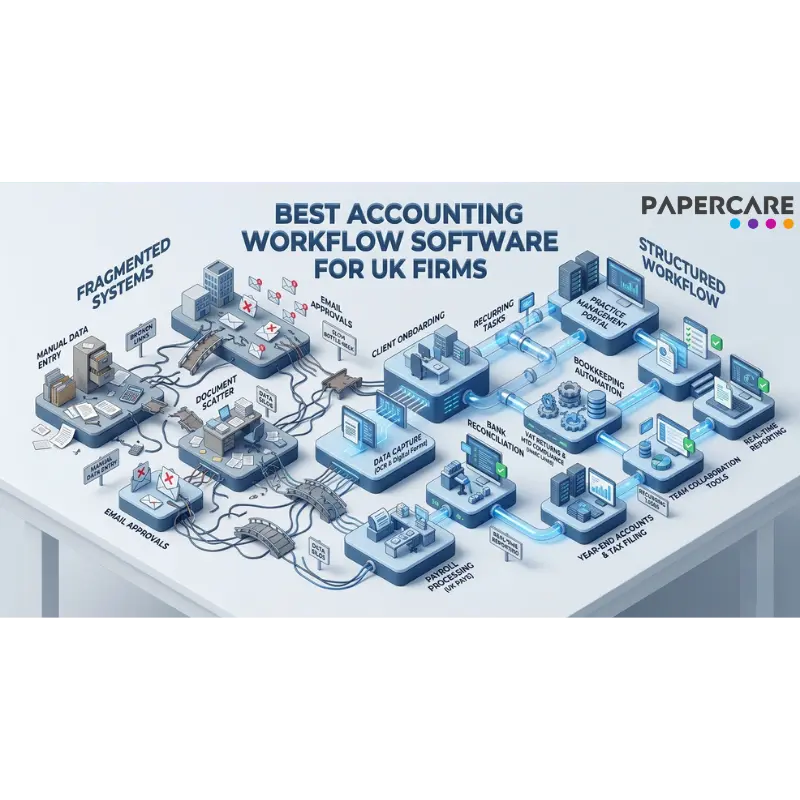
One of the most common issues in accounting firms is system fragmentation. Over time, firms tend to adopt multiple tools for different purposes:
- One for bookkeeping
- One for document storage
- One for communication
- One for working papers
Individually, each tool may perform well. However, when these systems do not integrate effectively, they create gaps in the workflow.
Information must be transferred manually between systems. This increases the risk of errors and consumes valuable time.
More importantly, it reduces visibility. Teams do not have a single, clear view of the entire workflow, making it harder to manage work efficiently. This fragmentation is often one of the biggest barriers to true efficiency.
Poor Process Design Limits Software Impact

Even the most advanced software cannot compensate for poorly designed processes.
In many firms, workflows have evolved over time without formal structure. Different team members may approach similar tasks in different ways, leading to inconsistency.
When software is introduced into this environment, it does not standardise the process. Instead, it adapts to the existing variability. This limits its effectiveness.
High-performing firms take a different approach. They define clear, consistent processes first, and then implement software to support those processes.
This ensures that technology enhances efficiency rather than simply digitising inefficiency.
The Overlooked Role of Working Papers
Working papers sit at the centre of most accounting workflows, yet they are often overlooked when firms think about efficiency.
Many firms continue to rely on traditional methods, such as spreadsheets or disconnected documents, to manage working papers. While familiar, these approaches introduce several challenges:
- Lack of standardisation
- Limited visibility
- Difficulty in collaboration
- Increased risk of errors
When working papers are not structured effectively, they create friction throughout the workflow. Improving efficiency requires addressing this core component, not just the surrounding tools.
Adoption Challenges Within Teams

Another factor that limits the impact of accounting software is adoption. Even when firms invest in the right tools, they may struggle to use them effectively. This can be due to:
- Lack of training
- Resistance to change
- Unclear processes
If team members do not fully understand how to use a system, they are likely to revert to familiar methods. This leads to inconsistent usage and reduces the overall benefit of the software.
Successful implementation requires more than just deployment. It requires ongoing support, training, and alignment across the team.
Efficiency Requires End-to-End Visibility

A key characteristic of efficient accounting firms is visibility. Teams need to understand:
- What work is in progress
- Who is responsible
- What stage each task is at
Without this visibility, managing workflows becomes reactive rather than proactive.
Many software tools focus on specific parts of the process, but do not provide a complete view. This creates blind spots that make it harder to identify bottlenecks and improve performance.
End-to-end visibility is essential for achieving consistent efficiency.
What Actually Works: A Systems Approach

If software alone is not the solution, what is?
The answer lies in taking a systems approach.
This means looking at the entire workflow as a connected system rather than a collection of individual tasks. It involves:
- Defining clear processes
- Standardising workflows
- Integrating tools
- Ensuring consistent usage
When these elements are aligned, software becomes far more effective. Instead of managing multiple disconnected tools, firms operate within a cohesive system that supports efficiency at every stage.
The Role of Structured Working Papers Systems
One of the most effective ways to improve efficiency is by introducing a structured working papers system.
Rather than relying on ad hoc documents or spreadsheets, structured systems provide:
- Consistent formats
- Centralised data
- Clear workflows
- Built-in checks
This reduces variability and makes it easier to manage work at scale. It also creates a foundation for automation and AI, which depend on structured data and predictable processes.
How Papercare Aligns with This Approach

Papercare is designed with this systems approach in mind. Instead of focusing solely on individual features, it provides a structured environment for managing working papers and workflows. This includes:
- Standardised templates
- Centralised data management
- Integrated workflows
- AI-enabled capabilities
By bringing these elements together, Papercare helps firms move away from fragmented systems and towards a more cohesive way of working.
The result is not just improved efficiency, but a more sustainable and scalable workflow.
The Risk of Continuing with the Wrong Approach
Firms that continue to rely on fragmented systems and poorly aligned processes are likely to face increasing challenges.
As workloads grow and expectations rise, inefficiencies become more costly. This can lead to:
- Increased pressure on teams
- Missed deadlines
- Reduced client satisfaction
Over time, these issues can impact both profitability and reputation. Addressing efficiency is no longer optional. It is essential for long-term success.
Looking Ahead: Efficiency as a Competitive Advantage

Efficiency is becoming a key differentiator in the accounting industry. Firms that operate efficiently can:
- Deliver work faster
- Take on more clients
- Provide better service
This creates a significant competitive advantage. As technology continues to evolve, the gap between efficient and inefficient firms is likely to widen.
Those that adopt a systems approach and invest in structured workflows will be better positioned to succeed.
Conclusion
The belief that software alone can improve efficiency is one of the most common misconceptions in the accounting industry.
While software is an important part of the solution, it is not the starting point. True efficiency comes from aligning processes, systems, and teams.
Firms that take this approach can move beyond the limitations of fragmented tools and create workflows that are both efficient and scalable.
In this context, platforms like Papercare are not just tools, but part of a broader shift towards more structured and effective ways of working.