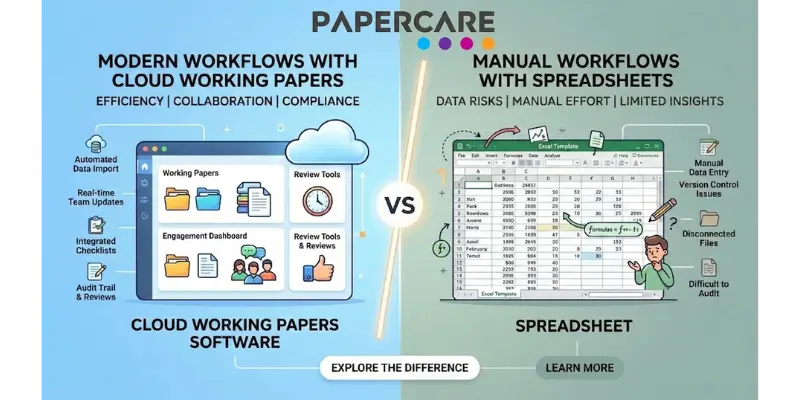
Spreadsheets have long been a core part of accounting workflows. For many UK accounting firms, tools like Excel have been used for years to prepare working papers, manage financial data, and support audit documentation.
However, as accounting work becomes more complex and compliance requirements increase, many firms are beginning to question whether spreadsheets are still the most effective solution.
At the same time, cloud-based working papers software is gaining adoption across the profession. These platforms are designed specifically for accounting workflows, offering structured documentation, automation, and real-time collaboration.
This raises an important question for modern accounting firms:
Should you continue using spreadsheets, or is it time to move to cloud working papers software?
In this article, we explore the key differences between the two approaches and what UK accounting firms should consider when making this decision.
Why Spreadsheets Became the Default in Accounting
Spreadsheets became widely used in accounting because they offered flexibility and control.
Accountants could create their own templates, customise calculations, and organise financial data according to their preferences. For many years, this made spreadsheets a practical and accessible solution for managing working papers.
Some of the key advantages of spreadsheets include:
- flexibility to design custom formats
- familiarity across accounting teams
- relatively low initial cost
- ability to handle a wide range of calculations
Because of these benefits, spreadsheets became the standard tool for preparing working papers in many firms.
However, as accounting workflows have evolved, the limitations of spreadsheets have become more apparent.
The Limitations of Spreadsheets in Modern Accounting

While spreadsheets remain useful in certain scenarios, they were never designed to handle the complexity of modern accounting workflows.
As firms grow and manage more engagements, relying on spreadsheets can introduce several operational challenges.
Many of these challenges are already well documented, including common spreadsheet issues in accounting workflows such as formula errors, broken links, and inconsistent data structures.
These issues can lead to:
- increased risk of errors
- time-consuming manual checks
- difficulty maintaining consistency across engagements
- challenges in reviewing and approving documentation
Another major limitation is the lack of proper version control. When multiple team members work on the same spreadsheet, it can be difficult to track changes or ensure everyone is working on the latest version.
In addition, spreadsheets do not provide structured workflows for preparing and reviewing working papers, which can slow down the audit and review process.
We put a figure on that time in the hidden cost of Excel in accounting firms.
What is Cloud Working Papers Software
Cloud working papers software is a modern solution designed specifically for accounting firms to manage engagement documentation more efficiently.
Unlike spreadsheets, these platforms provide a structured environment where working papers are created, organised, and reviewed within a single system.
If you are new to this concept, it may be helpful to understand working papers software in more detail and how it supports accounting workflows.
Cloud-based systems offer several advantages over traditional methods, including:
- centralised documentation storage
- real-time collaboration
- built-in validation and consistency checks
- structured workflows for preparation and review
These capabilities make cloud working papers software a more scalable and efficient solution for modern accounting firms.
Cloud Working Papers Software vs Spreadsheets
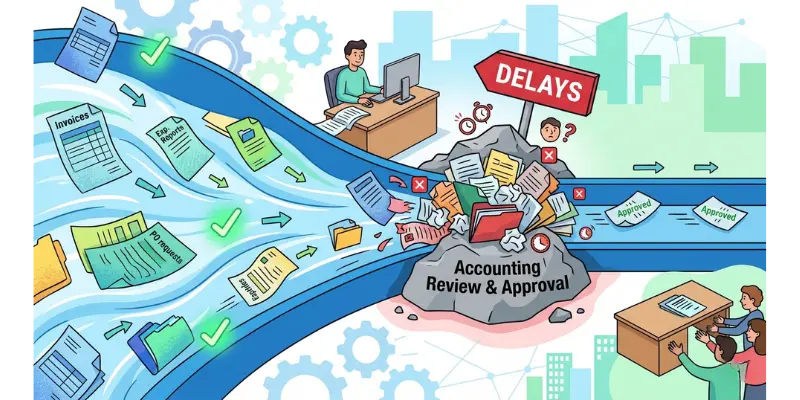
To better understand the difference, it is useful to compare how each approach performs across key areas of accounting workflows.
- Accuracy and Error Reduction
Spreadsheets rely heavily on manual input and formulas, which increases the risk of errors.
Even small mistakes, such as an incorrect formula or a broken link, can affect the accuracy of financial data.
Cloud working papers software reduces this risk by using structured templates and automated validation checks to ensure consistency.
Many modern platforms also use AI to identify anomalies and highlight potential issues before they become significant problems.
- Collaboration and Teamwork
Collaboration is often challenging when using spreadsheets, especially when multiple team members are involved in the same engagement.
Files may be shared through email or stored in different folders, leading to confusion and duplication.
Cloud-based systems allow multiple users to work on the same set of working papers simultaneously, with real-time updates and clear visibility into changes.
This improves team coordination and reduces delays.
- Efficiency and Time Savings
Preparing working papers manually in spreadsheets can be time-consuming.
Accountants often need to create templates, organise files, and perform repetitive checks.
Cloud working papers software streamlines these tasks through automation, allowing teams to complete work more efficiently.
As discussed in many firms, automation is becoming essential for accounting firms looking to manage increasing workloads without adding more resources.
- Compliance and Audit Readiness
Maintaining audit-ready documentation is critical for accounting firms.
Spreadsheets do not always provide a clear audit trail, making it difficult to track changes or demonstrate compliance during reviews.
Cloud working papers software includes built-in audit trails, version history, and structured documentation, making it easier to meet regulatory requirements.
- Scalability for Growing Firms
As accounting firms grow, managing multiple engagements through spreadsheets becomes increasingly complex.
Files become harder to organise, and maintaining consistency across engagements becomes more difficult.
Cloud systems are designed to scale with the firm, allowing teams to manage larger volumes of work without losing efficiency or control.
Benefits of Moving to Cloud Working Papers Software
For firms considering a transition, the benefits of cloud working papers software go beyond simple efficiency improvements.
Some of the key advantages include:
- improved accuracy through automated validation
- faster preparation and review processes
- better collaboration across teams
- consistent documentation standards
- secure, centralised storage of financial data
For many firms, the decision to move away from spreadsheets is not just about adopting new technology, but about improving the overall quality of their workflows.
If you are considering making this transition, understanding how to migrate from spreadsheets to a cloud working papers system can help ensure a smooth and structured implementation.
It helps that the data no longer has to be retyped. A trial balance import brings the client’s figures in straight from the bookkeeping software.
The Role of AI in Modern Working Papers
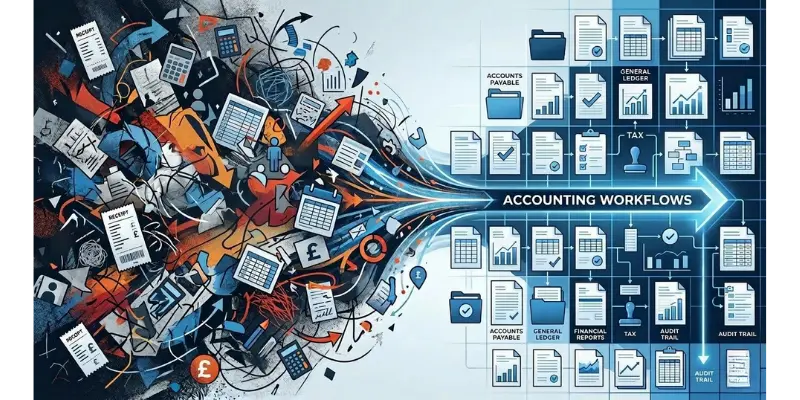
Artificial intelligence is playing an increasingly important role in accounting technology.
Modern working papers platforms are now using AI to support tasks such as:
- identifying inconsistencies in financial data
- validating calculations
- improving review efficiency
- structuring documentation automatically
These advancements are part of a broader trend in the industry, where AI is transforming working papers for UK accountants and helping firms move towards more intelligent and efficient workflows.
Taken far enough, this is what an AI accountant is: AI working papers software that prepares the schedules, checks they tie and drafts the review points, while a qualified person signs off. See our guide to the AI accountant.
How Papercare Working Papers Supports This Transition
For accounting firms looking to move beyond spreadsheets, Papercare Working Papers provides a modern solution designed specifically for today’s accounting environment.
Papercare is an AI-powered, cloud-based platform that helps firms streamline the preparation, review, and management of working papers.
Instead of relying on manual spreadsheets, Papercare enables firms to work within a structured system that improves accuracy, consistency, and collaboration.
Key capabilities include:
- automated creation and organisation of working papers
- AI-based validation and consistency checks
- real-time collaboration with role-based access
- centralised, audit-ready documentation
- improved efficiency in review and approval workflows
By adopting a platform like Papercare, accounting firms can modernise their workflows and reduce the limitations associated with traditional spreadsheet-based processes.
Final Thoughts
Spreadsheets have served the accounting profession well for many years, but they are no longer sufficient for managing the complexity of modern accounting workflows.
As firms face increasing regulatory requirements, larger volumes of data, and growing client expectations, the need for more efficient and structured systems is becoming clear.
Cloud working papers software offers a more advanced approach, providing automation, collaboration, and scalability that spreadsheets cannot match.
For UK accounting firms looking to improve efficiency and maintain high standards of documentation, moving to a cloud-based solution may be an important step towards future growth.
If your firm is currently relying on spreadsheets for working papers, it may be worth exploring how cloud-based solutions can improve efficiency and reduce manual effort.
Learn more about how Papercare Working Papers helps accounting firms streamline documentation and enhance collaboration by visiting www.papercare.ai
FAQs
Is working papers software better than spreadsheets?
Working papers software is generally more efficient than spreadsheets because it provides structured workflows, automation, and better collaboration features.
Why are accounting firms moving away from spreadsheets?
Accounting firms are moving away from spreadsheets due to issues such as errors, lack of version control, and inefficient manual processes.
What are the benefits of cloud working papers software?
Cloud working papers software improves accuracy, enables real-time collaboration, provides audit trails, and helps firms manage documentation more efficiently.
Can I still use Excel alongside working papers software?
Yes. Excel remains useful for one-off analysis. The working papers themselves, meaning the schedules, reconciliations and review trail, are safer in a system built for them.
Are AI working papers better than spreadsheets?
For review, yes. A spreadsheet cannot tell you what looks wrong. AI working papers can compare the file with the prior year and raise the points a reviewer would, before the reviewer opens it.
About the author
Written by the Papercare Team. Papercare is the AI accountant for UK accountancy practices: AI accounting software that imports the client’s data, builds AI working papers that tie, and raises review points before the partner opens the file. It was built inside a live UK practice by founder Shrineel Patel FCCA. More about Papercare